Introduction
NEP 2020 is a structural transformation of India's education system. Chapter 23 explicitly mandates integrating AI-driven learning, adaptive technologies, smart classrooms, and digital platforms across all school stages—from foundational years through secondary education.
The scale makes this mandate urgent: 14.71 lakh schools, 24.69 crore students, and 1.01 crore teachers across India's K-12 ecosystem means implementation must work at every level, not just in well-resourced urban schools.
Principals and teachers face a crowded EdTech marketplace where hundreds of platforms promise transformation, but few are designed specifically for NEP 2020's goals: personalised learning, teacher empowerment, competency-based progression, multilingual access, and parent engagement.
This guide evaluates the 10 most effective NEP 2020-aligned technology tools in use across Indian schools today—covering what each does, why it matters, and how to assess fit for your institution.
TL;DR
- NEP 2020 mandates technology integration across teaching, assessment, administration, and access
- Effective EdTech tools must cover personalised learning, multilingual content, and parent engagement
- Government platforms like DIKSHA and SWAYAM should be every school's foundational deployment
- AI-first platforms like Coschool deliver adaptive 1:1 learning at scale, addressing NEP's no-student-left-behind mandate
- Prioritise NEP alignment, ease of teacher adoption, and measurable outcomes—not brand name
Why NEP 2020 Makes Technology Non-Negotiable for Schools
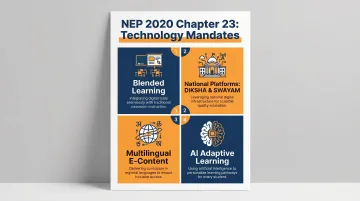
NEP 2020 dedicates an entire chapter—Chapter 23—specifically to "Technology Use and Integration." This chapter mandates that schools adopt tools across four areas:
- Supporting blended learning environments in classrooms
- Leveraging national platforms like DIKSHA and SWAYAM
- Providing high-quality e-content across all Indian languages
- Exploring AI-driven personalised and adaptive learning
These aren't suggestions—they're policy mandates.
The National Educational Technology Forum (NETF), established as an autonomous body, guides schools on which technologies to adopt, sets standards for online content quality, and evaluates innovations before national scaling. This body provides the institutional backbone for ensuring EdTech adoption is evidence-based rather than hype-driven.
That same evidence-based standard shaped this list. Each tool below was selected for direct alignment with NEP 2020's core pillars, proven classroom utility, and ability to serve India's diverse learner population.
Top 10 NEP 2020 Technology Tools for Schools
These tools were chosen based on their direct alignment with NEP 2020 goals, proven classroom effectiveness, ease of teacher adoption, and capacity to serve diverse learner needs across India's school system.
Coschool
Coschool is an AI-first education platform built on Generative AI, designed to achieve 1:1 personalised learning for every student while simultaneously empowering teachers with customisable classroom resources and engaging parents through actionable home-school insights.
Its AI Tutor (Vin) and AI Assistant enable real-time adaptive learning that adjusts to each student's knowledge gaps—directly fulfilling NEP's mandate for learner-centric, competency-based education. The platform also reduces teacher administrative burden, freeing educators to focus on instruction rather than grading and planning.
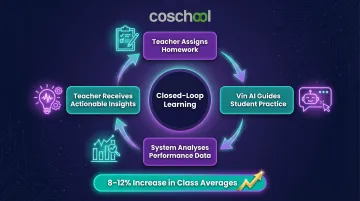
The closed-loop system works like this:
- Teachers assign homework through the platform
- Vin guides students with personalised support during practice
- The system analyses performance data automatically
- Teachers receive actionable insights to implement student-specific interventions
Schools using Coschool have demonstrated an 8-12% increase in class averages, with partner institutions consistently reaching 90-92% class performance through this process-driven approach.
| Aspect | Details |
|---|---|
| Key Feature | AI Tutor (Vin) delivers personalised, conversational learning that adapts to each student's pace and gaps in real time |
| NEP 2020 Alignment | Supports personalised learning, teacher empowerment, and parent partnership—three core pillars of NEP 2020 |
| Best For | Schools seeking a comprehensive AI-first solution for teachers, students, and parents under one platform |
DIKSHA (Digital Infrastructure for Knowledge Sharing)
DIKSHA is the Government of India's national digital platform for teachers and students, housing curriculum-aligned e-content, teacher professional development resources, and learning materials in multiple Indian languages, accessible even in low-connectivity environments.
DIKSHA stands out because it's the policy's own recommended infrastructure—free, scalable, government-backed, and directly integrated with the NCERT curriculum. Schools using DIKSHA ensure compliance with NEP's content and accessibility mandates from day one. As of July 2022, the platform hosted 2.91 lakh e-content pieces, 6,477 QR-coded textbooks, and content in 33 Indian languages, with 495+ crore learning sessions recorded. UNESCO reports that DIKSHA has been adopted by almost all States/UTs and CBSE, with over 182.3 million enrolments and 145.7 million course completions.
| Aspect | Details |
|---|---|
| Key Feature | Multilingual e-content and teacher CPD modules across all Indian states and boards |
| NEP 2020 Alignment | Directly mandated by NEP 2020 as the core platform for teaching-learning e-content delivery |
| Best For | All government and private schools seeking free, policy-compliant digital learning resources |
SWAYAM
SWAYAM is India's national MOOC platform offering courses across school and higher education levels, developed by top academic institutions. The platform features video lectures, downloadable materials, self-assessment tests, and discussion forums accessible to students and teachers nationwide.
SWAYAM supports NEP 2020's push for open, scalable learning beyond classroom walls—enabling students to access supplementary learning and teachers to pursue professional development through recognised online courses. NCERT coordinates school-level MOOCs on SWAYAM, with 28 ongoing courses and 5,139 students enrolled as of 2026. Platform-wide, SWAYAM recorded 5.2 million course enrollments in January 2026 across school and higher education levels.
| Aspect | Details |
|---|---|
| Key Feature | Free MOOCs from leading universities covering school-to-college level subjects |
| NEP 2020 Alignment | Supports open and flexible learning pathways and teacher professional development as outlined in NEP 2020 |
| Best For | Schools supplementing classroom instruction with structured online courses for students and teachers |
Google Workspace for Education
Google Workspace for Education is a collaborative suite—Classroom, Meet, Docs, Drive, Forms—that enables digital assignment management, virtual classes, collaborative projects, and formative assessments, available at low or no cost for qualifying schools.
Google Classroom, Meet, and Docs work within a single login—making blended and flipped classroom models practical without juggling separate platforms. Both models are explicitly promoted by NEP 2020. The Education Fundamentals edition is free, with Education Plus available at approximately $5 per user annually, making it accessible across diverse school budgets.
| Aspect | Details |
|---|---|
| Key Feature | Integrated LMS, video class, and collaboration tools in a single ecosystem |
| NEP 2020 Alignment | Enables blended learning, flipped classrooms, and collaborative project-based learning |
| Best For | Schools transitioning from fully offline to blended learning models with limited EdTech budgets |
Khan Academy
Khan Academy is a free, adaptive online learning platform offering video lessons, practice exercises, and personalised learning dashboards across subjects from foundational literacy to advanced maths and science—available in Hindi and several Indian languages.
Khan Academy's mastery-based approach ensures students only advance after demonstrating concept understanding—directly aligned with NEP 2020's competency-based progression model. A randomized controlled trial in Uttar Pradesh government boarding schools found supervised implementation produced 0.44–0.47 standard deviation higher math scores at approximately $24 (~₹2,000) per student annually.
Its zero-cost model makes it equally accessible across rural and urban schools.
| Aspect | Details |
|---|---|
| Key Feature | Mastery-based adaptive practice with real-time teacher progress dashboards |
| NEP 2020 Alignment | Supports competency-based learning, personalised pace, and equitable access to quality content |
| Best For | Schools with budget constraints seeking free, high-quality adaptive content in multiple languages |
Extramarks Smart Class Plus
Extramarks Smart Class Plus is a comprehensive school EdTech solution combining NEP-ready interactive content, smart classroom hardware (interactive whiteboards), online and offline assessments, student performance reports, and classroom administration tools.
Its in-house curriculum is regularly updated to reflect NEP 2020 changes, and the hardware + software + content bundle simplifies procurement for schools making a full digital transition. The integrated package includes:
- Teaching App and Learning App for classroom delivery
- Parent App for home-school communication
- Assessment Centre with lecture recording
- Analytics aligned to NEP 2020, NCF, and NCERT frameworks
| Aspect | Details |
|---|---|
| Key Feature | Interactive whiteboards + NEP-aligned gamified content + assessment module in an integrated package |
| NEP 2020 Alignment | Supports smart classroom setup, experiential learning, and continuous formative assessment |
| Best For | Schools investing in smart classroom infrastructure with curriculum-aligned interactive content |

Quizizz
Quizizz is a gamified assessment and quiz platform that allows teachers to create interactive quizzes, polls, and lessons—usable in real-time or as homework assignments, with instant performance analytics for each student.
NEP 2020 shifts assessment from summative to formative and continuous; Quizizz makes frequent, low-stakes formative assessment engaging rather than stressful, with data that helps teachers identify knowledge gaps quickly. Research on gamification in education found a medium positive effect on student learning performance (Hedges' g = 0.504). The platform supports Paper Mode for classes without 1:1 devices and offers AI-assisted content generation for teachers.
| Aspect | Details |
|---|---|
| Key Feature | Gamified quizzes with real-time student analytics and instant feedback |
| NEP 2020 Alignment | Supports continuous and formative assessment reform central to NEP 2020 |
| Best For | Teachers looking for a quick-to-deploy tool for regular, engaging classroom assessment |
Microsoft Teams for Education
Microsoft Teams for Education is a virtual classroom and collaboration platform offering video classes, assignment management, OneNote integration, and school-wide communication channels—supported by Microsoft's education-specific security and compliance standards.
Teams supports both synchronous and asynchronous learning, making it practical for hybrid and blended learning environments. Office 365 A1 (Education) is free for eligible institutions, with paid editions (A3 at ₹270/user/month, A5 at ₹670/user/month) available for advanced features. Its integration with Office tools prepares students with digital productivity skills aligned with NEP 2020's digital literacy goals.
| Aspect | Details |
|---|---|
| Key Feature | Virtual classroom + assignment management + school-wide communication in one platform |
| NEP 2020 Alignment | Enables blended and hybrid learning delivery, digital skill development, and teacher-student communication |
| Best For | Schools in urban and semi-urban areas already using Microsoft ecosystems seeking a scalable virtual classroom tool |
ClassDojo
ClassDojo is a classroom communication and parent engagement platform that allows teachers to share student progress, post class updates, and build two-way communication with parents—accessible via a simple mobile app with multilingual support in 130+ languages, including Hindi.
NEP 2020 strongly emphasises school-home partnerships and parent involvement in learning; ClassDojo operationalises this by keeping parents continuously informed and engaged—reducing the gap between classroom learning and home reinforcement. Parents receive real-time updates on their child's learning journey, creating transparency and enabling collaborative support.
| Aspect | Details |
|---|---|
| Key Feature | Real-time parent-teacher messaging, student portfolio sharing, and classroom updates via mobile |
| NEP 2020 Alignment | Directly supports NEP 2020's emphasis on involving parents as active partners in the learning process |
| Best For | Schools prioritising parent engagement and transparent home-school communication |
Scratch (by MIT)
Scratch is a free visual programming platform developed by MIT that teaches computational thinking and coding through block-based, drag-and-drop programming—appropriate for students from Grade 3 onwards and designed to introduce logical reasoning and creative problem-solving.
NEP 2020 explicitly includes coding and computational thinking in the school curriculum from Grade 6 onwards; Scratch provides a no-barrier entry point that teachers without coding backgrounds can effectively use. The platform offers a multilingual interface including Hindi and Odia, with a large library of community-built projects that students can remix and learn from.
| Aspect | Details |
|---|---|
| Key Feature | Visual block-based coding platform with project-sharing community and multilingual interface |
| NEP 2020 Alignment | Supports NEP 2020's mandate for coding education and computational thinking from middle school onwards |
| Best For | Schools introducing coding and digital creativity into curriculum without requiring specialist programming teachers |
How We Selected These 10 Tools
Each tool was assessed against NEP 2020's core technology pillars—personalised learning, teacher empowerment, equitable access, continuous assessment, and multilingual support. Tools that addressed multiple pillars ranked higher than single-purpose solutions.
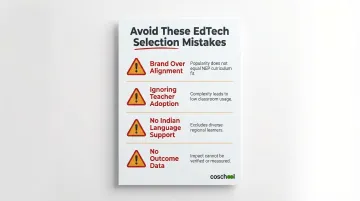
Common mistakes schools make when choosing EdTech include:
- Selecting tools based on brand popularity or pricing alone, without checking NEP alignment
- Ignoring teacher adoption ease—complex tools create resistance and low usage
- Overlooking whether platforms support Indian languages and low-bandwidth environments
- Failing to verify whether tools provide measurable learning outcome data
Before committing institution-wide, pilot with a small cohort, collect teacher and student feedback, and verify that the tool produces actionable learning outcome data.
That piloting process should also surface infrastructure gaps. UDISE+ 2024-25 data shows only 58% of schools have functional computers for pedagogy and 63.5% have internet connectivity — even as 93.7% have electricity. Cloud-dependent platforms will underperform where connectivity is unreliable, so assess your school's infrastructure before finalising any tool.
Conclusion
NEP 2020's technology vision isn't about replacing teachers. It's about giving teachers the right tools to personalise instruction and assess student progress, so every student receives quality learning regardless of background.
School leaders should prioritise tools that serve multiple stakeholders — teachers, students, and parents — and can scale with the institution. Fragmented, isolated solutions create inconsistent experiences and siloed data. The most successful implementations use government-mandated platforms like DIKSHA as the baseline, then layer purpose-built tools to address specific learning gaps.
When evaluating your school's tech stack, look for solutions that:
- Work alongside DIKSHA rather than duplicating it
- Give teachers actionable data, not just dashboards
- Engage parents as active partners in learning
- Adapt to individual student progress in real time
For schools looking to bring together AI-powered student support, teacher productivity tools, and parent engagement under a single NEP 2020-aligned platform, Coschool was built for exactly this. Its AI tutor Vin delivers personalised, conversational learning for students; its teacher tools generate classroom resources and track performance gaps; and its parent engagement features keep families informed in real time. Explore how Coschool can help your school move from fragmented tools to a connected learning experience.
Frequently Asked Questions
What are examples of technology tools for schools under NEP 2020?
Key examples span multiple categories: government platforms (DIKSHA, SWAYAM), AI-powered learning tools (Coschool), smart classroom solutions (Extramarks Smart Class Plus), assessment tools (Quizizz), coding tools (Scratch), and communication platforms (ClassDojo). NEP 2020 encourages a multi-tool approach covering learning, assessment, and administration rather than relying on a single platform.
What is the 70 30 rule in teaching?
The 70-30 rule describes a pedagogy model where 70% of learning is experiential (projects, discussions, problem-solving) and 30% is formal instruction. It aligns with NEP 2020's push toward competency-based learning, though it is not an officially defined NEP term.
How does NEP 2020 recommend using technology in classrooms?
NEP 2020 recommends technology for personalised learning, blended classrooms, continuous assessment, and multilingual content delivery. It specifically calls for AI-driven adaptive learning and online diagnostics, with NETF setting the standards for implementation.
What is DIKSHA and how does it support NEP 2020?
DIKSHA is the Government of India's national digital platform housing curriculum-aligned e-content in all major Indian languages, along with teacher training resources. NEP 2020 mandates it as the primary infrastructure for digital content delivery, making it the first platform schools should adopt.
What challenges do schools face when implementing EdTech under NEP 2020?
Main barriers include inadequate digital infrastructure (especially in rural areas), insufficient teacher training, device and connectivity gaps, data privacy concerns, and difficulty selecting tools that align to NEP's goals rather than generic EdTech. Schools see better outcomes when they address infrastructure and run pilots before scaling.
How can AI tools help teachers implement NEP 2020 goals?
AI tools cut administrative load through auto-grading, attendance tracking, and reporting, freeing teachers to focus on instruction. They also identify student knowledge gaps in real time and generate personalised learning paths—giving teachers the data they need to intervene early and effectively.