Adaptive learning offers exactly that solution. It's an AI-powered approach that personalises the learning path for every student based on their unique performance, pace, and needs. This guide explores how adaptive learning works, the benefits it delivers, and what it means for modern K-12 classrooms.
TLDR
- Adaptive learning uses AI and algorithms to personalise content, pace, and feedback for each student
- Three core mechanisms drive this: adaptive content, adaptive sequencing, and dynamic assessment that adjusts to each learner's level
- For teachers, the payoff is tangible — personalised learning at scale, higher engagement, and real-time data on every student
- Unlike manual differentiation, adaptive systems track every interaction automatically and adjust in real time
What Is Adaptive Learning?
Adaptive learning is an educational method that uses data, AI, and algorithms to deliver customised learning experiences. Rather than following a one-size-fits-all curriculum, adaptive systems adjust content, pace, and feedback in real time to meet each learner's individual needs.
Historical Context
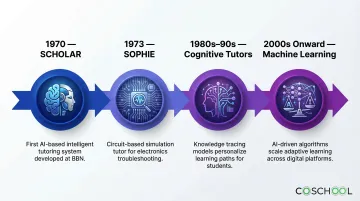
The roots of adaptive learning stretch back to the 1970s. The SCHOLAR system, created by Jaime R. Carbonell in 1970, remains the first intelligent tutoring programme on record. It used natural language interactions and semantic networks to adapt South American geography lessons to learner responses — a decisive shift from frame-based instruction to AI-driven tutoring.
Key milestones in adaptive learning's evolution:
- 1970 — SCHOLAR introduces the first AI-driven tutoring system
- 1973 — SOPHIE demonstrates early interactive electronics simulations
- 1980s–90s — Cognitive tutors like the PUMP Algebra Tutor use knowledge tracing for mastery practice
- 2000s onward — Machine learning makes adaptive systems scalable for everyday classrooms
Today, these foundational ideas power platforms used across schools in India and globally — processing millions of learner interactions to personalise instruction at scale.
Understanding the Terminology
Adaptive learning comes with several overlapping terms worth knowing:
- Adaptive learning — the broader educational methodology
- Adaptive software — the underlying technology platform that powers personalisation
- Adaptive courseware — subject-specific digital lessons built on adaptive platforms
- Adaptive teaching — the instructor's practice of adjusting instruction based on learner data
How Does Adaptive Learning Work?
Adaptive learning systems operate through three interconnected layers: data collection, decision-making, and personalised delivery.
Data Collection Layer
Adaptive systems continuously monitor multiple signals from learners:
- Performance data: Assessment scores, quiz results, error patterns
- Engagement data: Time spent on content, interaction frequency, resources accessed
- Self-reported data: Confidence levels, help requests, stated preferences
These signals feed into the system's decision engine, creating a real-time picture of each student's understanding.
Decision-Making Approaches
Two primary methods guide what the learner encounters next.
Designed Adaptivity lets educators build rule-based sequences — for example: "If a student scores below 60% on fractions, route them to a prerequisite video on division before continuing." This gives teachers direct control over the learning logic.
Algorithmic Adaptivity relies on AI to automatically determine the next step based on demonstrated knowledge. Two common models include:
- Bayesian Knowledge Tracing (BKT): Traces the probability a student knows a specific skill, updating estimates with each attempt. When mastery probability reaches a target threshold, the system advances the learner. BKT has been shown to predict post-test performance effectively.
- Item Response Theory (IRT): Models the probability of a correct response based on latent ability and item difficulty. IRT is used extensively in computer-adaptive assessments to select items and estimate ability accurately.
Key Outputs: Real-Time Support
Adaptive systems deliver two critical outputs:
Real-Time Feedback:
Students receive hints, encouragement, and targeted explanations at the exact moment they struggle. Rather than waiting for a graded test, support arrives when it matters most.
Differentiated Learning Pathways:
Advanced learners skip mastered concepts and move forward; struggling students receive additional scaffolding before progressing.
A Concrete Classroom Example
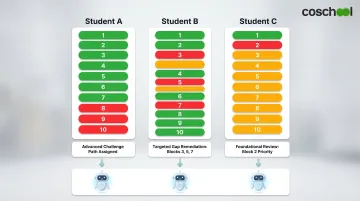
Imagine a maths unit covering 10 concepts:
- Student A has gaps in concepts 8, 9, and 10 — the later, more complex material
- Student B shows uneven progress, stumbling on concepts 3, 5, and 7
- Concept 2 is where Student C falls short, and it quietly impacts 30% of their overall result
In a traditional classroom, the teacher moves everyone forward together. In an adaptive system, the software identifies each unique gap and responds accordingly — reviewing prerequisite knowledge for Student C, reinforcing later concepts for Student A, and providing targeted practice for Student B.
This kind of gap-specific response is what separates adaptive platforms from traditional instruction. Coschool's AI tutor Vin does exactly this — delivering personalised, conversational support to each student in real time, while giving teachers clear data on where every learner actually stands.
Types of Adaptive Learning
Adaptive Content
Adaptive content responds to a student's specific answer with targeted feedback (hints, review materials, or scaffolding) without changing the overall skill sequence. This is an upgrade from simply marking answers correct or incorrect. When a student selects the wrong answer, adaptive content might provide a hint about the relevant skill or present a worked example before allowing another attempt.
Adaptive Sequence
Adaptive sequence continuously analyses student performance to automatically change what the student encounters next: the order of skills, the type of content, and the pace of progression. This creates a truly non-linear, personalised learning path.
In practice, the difference is significant:
- A student who masters multiplication quickly might skip repetitive practice and move straight to division
- A peer who struggles might loop back to review foundational concepts before advancing
Adaptive Assessment
Adaptive assessment changes question difficulty based on each previous response: questions get harder as a student answers correctly and easier when they struggle. This approach is used both within lessons (to maintain optimal challenge levels) and in computerised adaptive testing (CAT) for benchmarking student ability accurately.
Key Benefits of Adaptive Learning for Students and Teachers
Personalised Learning at Scale
A single teacher cannot realistically tailor instruction to 30+ students simultaneously. Adaptive systems make this achievable. RAND research examining 62 personalised learning schools found that student achievement growth in mathematics and reading over two years exceeded that of matched students in non-personalised schools. A subsequent RAND study of 32 schools found estimated treatment effects of 0.09 in mathematics (roughly 3 percentile points for a median student), with about 60% of students in the lowest four achievement quintiles surpassing comparison peers.
Student Autonomy and Self-Paced Progress
Students can bypass concepts they have already mastered — saving time — and spend more time on concepts where they struggle, without the anxiety of falling behind the class or the boredom of covering known material. Adaptive systems commonly use pre-knowledge assessments to determine starting points, so each student starts at their actual readiness level rather than an assumed one.
Improved Engagement and Knowledge Retention
Engagement increases when learning content closely matches a student's readiness level — neither too easy nor too frustrating. While much of the large-scale research on engagement has focused on higher education, the principle holds: when students work within their zone of proximal development (the range just beyond what they already know), they stay motivated and retain knowledge more effectively.
Teacher Empowerment Through Real-Time Data
Adaptive systems give teachers a live dashboard of individual and group progress, enabling timely interventions. Rather than waiting for end-of-term results, teachers can identify which students need support before they fall at risk of withdrawal and compare data across terms for continuous improvement.
Platforms like Coschool combine adaptive learning data with practical teacher tools, so educators spend less time diagnosing problems and more time addressing them. Teachers get access to:
- Customisable lesson plans aligned to current student needs
- Question banks for targeted practice
- Actionable insights on each student's progress, strengths, and gaps
Closing Learning Gaps Early
Adaptive learning identifies specific knowledge gaps at the concept level, not just overall grades. This means a student struggling with fractions can get targeted help before that gap affects their understanding of algebra. For students who rarely voice confusion in class, adaptive systems surface those misunderstandings before they silently widen.
Adaptive Learning in the Classroom: Real-World Examples
Adaptive learning works across classroom formats — face-to-face, hybrid, and fully online — and is particularly valuable in large-enrolment classes or schools with high student-to-teacher ratios.
Real-World K-12 Examples
| Subject & Level | Platform | What It Does |
|---|---|---|
| Maths, K-5 | DreamBox Learning | Adapts difficulty and sequencing based on individual error patterns; rated "potentially positive" for maths achievement by the What Works Clearinghouse |
| Reading/Literacy, K-1 | Lexia Reading | Assigns texts at each student's exact reading level and personalises the sequence of phonics, fluency, and comprehension skills |
| Secondary Maths, India | Coschool's SchoolAI (Vin) | Schools have achieved 8–12% increases in class averages, consistently breaking through the 70–85% performance plateau to reach 90–92% |
The Teacher's Essential Role
Adaptive systems do not replace teachers — they free them from manual progress tracking. With the system handling personalisation at scale, teachers can direct their attention toward facilitated discussions, targeted interventions, and building student relationships.
The technology surfaces the data; teachers supply the judgement and cultural awareness needed to act on it.
Adaptive Teaching vs. Traditional Differentiation
What is Differentiation?
Differentiated Instruction (DI), popularised by Carol Ann Tomlinson, is a teaching strategy where one teacher plans multiple instructional approaches for different learner groups within the same lesson. Teachers proactively modify three dimensions to address readiness, interests, and learning profiles:
- Content — what is taught
- Process — how students make sense of ideas
- Product — how learning is demonstrated
DI is a well-established and valuable pedagogy. In practice, though, it depends entirely on the teacher's capacity, time, and ability to track each student's needs accurately.
Research by Tomlinson et al. (2003) found that most teachers make few proactive modifications based on learner variance. Adaptations tend to be reactive, and consistent implementation is a real challenge in heterogeneous classrooms.
Why Adaptive Teaching Offers Advantages at Scale
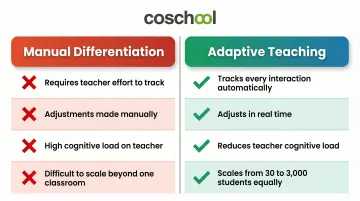
Adaptive systems:
- Track every interaction automatically without teacher effort
- Adjust in real time without requiring manual lesson redesign mid-session
- Reduce cognitive load on teachers by automating progress monitoring and gap identification
- Serve a class of 30 or a school of 3,000 with the same personalisation fidelity
They Work Best Together
Adaptive teaching and differentiation work best together, not in competition. Adaptive technology handles the data-driven personalisation layer, while teachers apply their professional judgement, cultural awareness, and relationship-building to act on those insights. The result: more students get the right support at the right time, without placing the entire burden of tracking and adjusting on the teacher.
Frequently Asked Questions
What is adaptive learning?
Adaptive learning is an AI- and algorithm-driven educational methodology that adjusts content, pace, and feedback in real time to meet each individual learner's unique needs.
What are the benefits of adaptive learning?
Key benefits include personalised learning at scale, improved engagement and knowledge retention, self-paced progress, and early identification of learning gaps. Teachers also gain data-driven insights to intervene before students fall behind.
What are adaptive learning tools?
Adaptive learning tools are software platforms and AI-powered systems that collect learner data and personalise content, assessments, and learning pathways based on individual performance. Examples include intelligent tutoring systems, adaptive LMS platforms, and AI tutors.
What are examples of adaptive learning?
Examples include a maths app that adjusts question difficulty based on student answers, a reading platform that assigns texts at each student's exact level, or a school using an AI tutor like Coschool's Vin to give every student personalised explanations of concepts they have not yet mastered.
What is adaptive teaching?
Adaptive teaching is the practice of continuously adjusting instructional approaches, content, and feedback in response to student performance — whether by a teacher or an AI-powered teaching assistant.
Why is adaptive teaching better than differentiation?
Technology-powered adaptive teaching scales personalisation far beyond what manual differentiation allows — tracking progress automatically and adjusting in real time. The two approaches work best together, with technology handling data-driven personalisation and teachers contributing professional judgement and relational skills.