Introduction
In a classroom of 30 students learning at different paces, how does a single teacher ensure no child falls behind? UNESCO projects a global shortage of 44 million primary and secondary teachers by 2030. This gap makes the question harder to answer each year.
In India, the picture is just as uneven. Pupil-teacher ratios range from 32:1 in Bihar's primary schools to 6:1 in Ladakh and Sikkim, with the national average sitting around 21 students per teacher.
AI-based Intelligent Tutoring Systems (ITS) are built to solve this problem. These platforms use artificial intelligence to replicate one-on-one tutoring at scale, adapting content, pace, and feedback to each individual learner in real time, no matter the class size.
This review covers what ITS are, how they work, where they deliver results, and where the technology is headed next.
Key Takeaways
- ITS are AI-powered programs that deliver personalised, adaptive instruction to individual learners without constant teacher intervention
- ITS operate through four core components: domain model, student model, tutoring model, and user interface
- Research shows ITS consistently outperform traditional classroom instruction and can match expert human tutors in step-based learning tasks
- Key limitations include high development costs, limited emotional intelligence, and reduced effectiveness in open-ended or creative subjects
- Modern Generative AI is transforming ITS from rigid rule-based systems into conversational tutors capable of dynamic, natural-language instruction
How Do Intelligent Tutoring Systems Work? The 4 Core Components
Unlike traditional Computer-Aided Instruction (CAI), which uses fixed, one-size-fits-all question sequences, ITS continuously evaluates each learner's response and dynamically adjusts what content to present next, a process called model tracing. This adaptation separates ITS from simple digital worksheets.
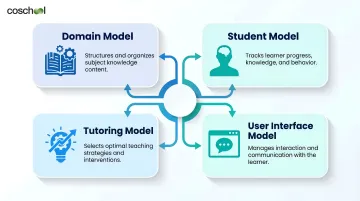
Every ITS is built on four fundamental components, each serving a distinct role in creating personalised instruction:
The Domain Model
The domain model (also called the expert or knowledge model) is the backbone of any ITS. It houses all subject-specific knowledge, concepts, rules, and problem-solving strategies.
Acting as the benchmark against which student performance is compared, the domain model enables the system to pinpoint where a learner's understanding deviates from expert knowledge. It functions as the system's internal expert: a complete map of everything a student needs to master.
The Student Model
The student model is the ITS's real-time profile of each individual learner. It tracks what they know, what they don't, their learning pace, and their preferred learning style. This model updates in real time as the student interacts with the system, allowing the ITS to identify learning gaps at a granular level, detecting not just that a student struggles with algebra, but precisely which subtopics require intervention.
The Tutoring (Pedagogical) Model
The tutoring model draws from both the domain and student models to select the most effective instructional strategy for that specific learner at that specific moment. It decides when to introduce new topics, when to review, how much scaffolding to provide, and when to increase problem difficulty. This is where the "intelligence" of tutoring happens: the system replicates the adaptive decision-making that expert human tutors perform intuitively.
The User Interface Model
The user interface is how the ITS communicates with the student, presenting problems, collecting responses, and delivering feedback in a clear and engaging manner. Modern ITS are shifting toward natural language and conversational interfaces, enabled by Generative AI. This evolution makes systems feel less like software and more like dialogue with a human tutor.
At a glance, what each component does:
| Component | Primary Role |
|---|---|
| Domain Model | Stores subject knowledge; benchmarks expert understanding |
| Student Model | Tracks individual knowledge, pace, and learning gaps in real time |
| Tutoring Model | Selects instructional strategy based on domain + student data |
| User Interface Model | Delivers content, collects responses, and provides feedback |
Key Benefits of AI-Based ITS for Students and Teachers
Personalised Learning at Scale
The most significant benefit of ITS is the ability to deliver differentiated, one-on-one instruction to every student simultaneously, something no single teacher can achieve in a classroom of 30+.
Benjamin Bloom's seminal 1984 study documented what became known as the "2-sigma problem": one-to-one tutoring with mastery learning produced roughly a 2 standard deviation improvement over conventional classroom instruction, meaning the average tutored student performed above 98% of the control class.
That 2-sigma benchmark set the standard. Kurt VanLehn's 2011 meta-analysis found step-based ITS achieved a mean effect size of 0.76 over classroom instruction. Overall ITS averaged 0.58, compared to human tutoring's median of 0.79. The gap between software and expert human tutors is narrowing.
Immediate, Targeted Feedback
ITS provides real-time feedback on every student response, not just "right or wrong" but contextual explanations of why an answer is correct or incorrect. Unlike waiting for a teacher to grade homework, this prevents misconceptions from taking hold and reinforces understanding in the moment.
Research on formative feedback shows that timely, specific feedback improves learning outcomes. Discovering an error immediately, rather than days later, determines whether a student corrects their thinking or deepens the wrong pattern.
Identifying and Closing Learning Gaps
ITS continuously tracks the specific concepts a student hasn't mastered and directs practice toward those gaps specifically, rather than moving the whole class forward when some students are still struggling.
Vin, the AI tutor inside SchoolAi by Coschool, for example, identifies gaps at a granular concept level, redirects each student's learning pathway accordingly, and tracks progress until mastery is confirmed, so no student moves forward on a shaky foundation.
Empowering Teachers with Actionable Data
ITS doesn't replace teachers, it equips them. By collecting granular performance data across all students, ITS gives teachers insight into:
- Class-wide learning patterns
- At-risk learners requiring intervention
- Effectiveness of instructional approaches
- Specific concepts where the majority of students struggle
This allows teachers to use their time more intentionally for human connection, mentorship, and complex instruction while the system handles continuous assessment and gap identification.
Scalability and Educational Equity
ITS makes high-quality, personalised instruction accessible regardless of class size, geography, or socioeconomic background. In settings where teacher-to-student ratios are high, such as Bihar's 32:1 primary school average, AI tutoring can help close disparities in learning outcomes between well-resourced and under-resourced schools.
Challenges and Limitations of ITS
High Development Cost and Complexity
Building a robust ITS is expensive and time-intensive. Research has documented ratios of development time to instruction time as high as 200:1 hours for systems like Carnegie Learning's Cognitive Tutor. This cost barrier limits the number of quality ITS available and concentrates them in well-funded contexts.
Modern AI authoring tools and Generative AI are beginning to lower this barrier. Preliminary research suggests LLM-based tutoring systems require minimal content preparation compared to traditional ITS pipelines, potentially reducing development costs significantly. Rigorous cost benchmarking is still emerging, so exact savings remain unclear.
Limited Emotional and Social Intelligence
Current ITS struggle to recognise and respond to a student's emotional state, such as frustration, boredom, anxiety, or disengagement. Without this dimension, ITS risk missing crucial affective signals that a human teacher would naturally pick up on.
Research on affective tutoring systems shows that emotions directly impact learning: confusion (when resolved) and flow states are associated with gains, while boredom and persistent frustration predict poorer outcomes. The emerging field of Affective Tutoring Systems (ATS) uses multimodal signals, including facial expressions, physiology, and interaction traces, to detect and respond to learner affect, directly targeting this gap in emotional responsiveness.
Subject Coverage Gaps and the Risk of Over-Reliance
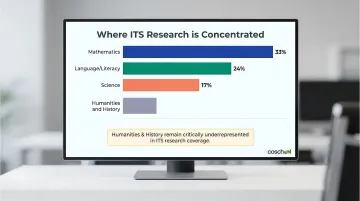
ITS works best for well-defined, procedural subjects like mathematics, coding, and science, but struggles with open-ended domains like creative writing, critical thinking, or social studies. A systematic review found most ITS research concentrated in:
- Mathematics: 33% of studies
- Language/Literacy: 24% of studies
- Science: 17% of studies
- Humanities and History: significantly underrepresented
This subject concentration matters because it shapes where ITS gets deployed, and where gaps in student support remain. A related risk is students "gaming" hint systems, exploiting help features to complete tasks without genuine understanding. Studies on gaming behavior show it correlates with lower post-test performance, underscoring the need to balance ITS use with traditional teacher-led instruction and peer interaction.
Real-World Applications: Notable ITS Examples and Platforms
K-12 and Higher Education Platforms
Carnegie Learning's Cognitive Tutor is one of the most widely studied ITS platforms, using model tracing and knowledge tracing based on ACT-R cognitive models to teach algebra. Research on its implementation documents both effectiveness and the practical time splits required for classroom rotation models.
AutoTutor uses natural language dialogue to teach computer literacy and other subjects. Developed by Art Graesser and collaborators, studies show it improves learning outcomes through conversational tutoring that adapts to student responses.
ASSISTments provides math practice with immediate feedback, hints, and teacher reports. Developed at Worcester Polytechnic Institute, it's used by hundreds of thousands of students, offering formative assessment integrated into daily assignments.
Corporate and Military Training Applications
ITS has found significant adoption in high-stakes, procedural training contexts:
- SHERLOCK (U.S. Air Force) trained technicians to troubleshoot F-15 electronics
- Cardiac Tutor taught medical personnel cardiovascular procedures
- GIFT (Generalized Intelligent Framework for Tutoring), developed by the U.S. Army Research Laboratory, provides an open, domain-independent ITS framework to reduce authoring burden and standardise components
These environments are ideal for ITS deployment because learning objectives are clearly defined, performance is objectively measurable, errors carry real consequences, and the cost of learning gaps is high.
The Rise of Generative AI-Based Tutors
The shift from classical rule-based ITS to conversational, LLM-powered tutors is the most significant development in the field's recent history. This new generation can engage in natural dialogue, answer novel questions, and guide students through Socratic questioning without requiring pre-scripted response trees.
Khan Academy's Khanmigo, powered by GPT-4, launched in 2023 and has seen rapid adoption, with reported student usage growing from 40,000 to 700,000 in 2024–25. That trajectory signals a broader shift: AI tutoring is no longer limited to well-defined domains like algebra or electronics. It can now operate across subjects, grade levels, and learning styles at scale.
The Future of AI-Based Intelligent Tutoring Systems
Conversational and Generative AI Tutors
The integration of large language models (LLMs) into ITS is expanding what's possible. Unlike rule-based systems that follow predetermined paths, LLM-powered tutors can hold open-ended dialogue, adjust explanations dynamically, and respond to student curiosity rather than just pre-programmed question paths.
A randomized controlled trial of GPT-4 as a homework tutor showed improved student engagement and grammar outcomes with minimal content preparation required. That said, research also cautions about the risks of hallucinated feedback in math tutoring, underscoring the need for quality control before wide deployment.
Emotional AI and Teacher-AI Collaboration
Emerging ITS capabilities include detecting learner affect, including frustration, confidence, and boredom, through interaction patterns, facial expression analysis, and response times. Research on multimodal affect detection shows systems can identify key emotional states and adapt instruction accordingly, providing encouragement during frustration, for example, or increasing challenge during flow states.
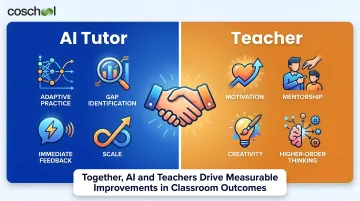
This emotional intelligence is what separates adaptive AI tutors from static digital content, and it's what makes teacher-AI collaboration so powerful. In this model, each side focuses on what it does best:
- The AI handles adaptive practice, gap identification, and immediate feedback at scale
- The teacher focuses on motivation, mentorship, creativity, and higher-order thinking
Platforms like SchoolAi by Coschool are built around this balance, using Generative AI to deliver 1:1 learning while giving teachers the insights to lead more meaningful classroom experiences. Schools using SchoolAi by Coschool have reported 8–11% increases in class averages, a result of personalised AI support working alongside expert teaching rather than replacing it.
Expanding Access and Reducing Educational Inequality
AI tutoring can bring consistent, personalised support to students in large, under-resourced classrooms across developing countries. India's government reported that AI adoption in education is growing at 25–35% annually, with over 2 million Indian students accessing AI tutoring features by late 2025.
In classrooms with severe teacher shortages and high pupil-teacher ratios, ITS fills a gap that neither policy nor infrastructure has been able to close. When a student in a rural school gets the same quality of adaptive feedback as one in a well-funded urban school, the technology is doing something structurally important. Not just improving scores, but redistributing access to quality learning.
Frequently Asked Questions
What is an intelligent tutoring system mainly used for?
ITS are primarily used to deliver personalised, adaptive instruction to individual learners, adjusting content, pacing, and feedback based on each student's knowledge level and learning gaps without requiring a human tutor for every interaction.
What are the components of an intelligent tutoring system?
ITS have four standard components: the domain model (subject knowledge), the student model (learner profile), the tutoring/pedagogical model (instructional strategy), and the user interface (how the system communicates with the learner).
How effective are intelligent tutoring systems?
ITS consistently outperform traditional classroom instruction in skill acquisition. VanLehn's 2011 meta-analysis and Kulik & Fletcher's 2016 review both show that step-based ITS can match the effectiveness of expert human tutors in skill acquisition.
What are examples of intelligent tutoring systems?
Prominent examples include Carnegie Learning's Cognitive Tutor (algebra), AutoTutor (computer literacy), ASSISTments (math), SHERLOCK (military technical training), and newer conversational AI tutors built on large language models.
Which platforms use intelligent tutoring systems today?
Modern ITS platforms include Carnegie Learning, Khan Academy's Khanmigo, and AI-first platforms like SchoolAi by Coschool that use Generative AI to deliver conversational, adaptive tutoring across K-12 schools.
What are the 4 S's of adaptive teaching?
The 4 S's, Structure, Scaffolding, Support, and Student-centered approach, are core principles of adaptive teaching. ITS are designed around these same principles, adjusting instruction dynamically based on each learner's current level.