Introduction
Picture a classroom of 45 students. One child grasps quadratic equations instantly. Another is still struggling with basic algebra. A third missed the foundational lesson on fractions two years ago and has been faking comprehension ever since. Yet all three receive the same lesson, at the same pace, from the same teacher — because that's how traditional classrooms work.
A McKinsey study found that students who fall behind can lose 15-24 weeks of learning — nearly half a school year — and those gaps compound over time. In India, ASER 2024 data reveals that 76.6% of Class III students in government schools cannot read a Class II-level text.
The technology to address this has evolved dramatically. Static Learning Management Systems gave way to adaptive platforms that adjust difficulty based on performance. Now, AI-powered tutors engage students in real conversation — giving every child the experience of a personal tutor, at classroom scale.
This guide maps that evolution. It helps educators, school leaders, and parents understand which solution fits their stage of the personalization journey, what each technology can realistically deliver, and what to look for when choosing.
TLDR
- Personalized learning tailors content, pace, and support to each student's unique needs — moving away from one-size-fits-all instruction
- LMS platforms organize and deliver content but don't adapt to individual performance in real time
- Adaptive platforms adjust difficulty and sequencing based on ongoing student responses and performance data
- AI-powered learning enables conversational, real-time, 1:1 experiences at classroom scale through natural language interaction
- Choosing the right solution depends on your school's goals, teacher readiness, and how deeply you want to personalize
Why the One-Size-Fits-All Classroom Is Failing Students
Traditional classrooms operate on an industrial model: all students move through the same content at the same pace, regardless of prior knowledge, learning style, or comprehension speed. Fast learners sit bored. Struggling learners fall further behind. Neither group realizes the extent of the problem until it's too late.
Knowledge Gaps Compound Rapidly
When a student misses or misunderstands a foundational concept — say, the relationship between fractions and decimals — and the class moves on regardless, that gap doesn't stay static. It compounds. McKinsey's research on pandemic learning loss found that students fell 15-24 weeks behind in math and 9 weeks behind in reading compared to 2019 benchmarks, effectively erasing two decades of progress. Students in the lowest-performing quartile fell an additional 6+ weeks behind their top-quartile peers, demonstrating how gaps widen disproportionately over time.
India's Foundational Learning Crisis
The scale of unaddressed gaps in India is staggering. ASER 2024 surveyed 649,491 children across 17,997 villages and found:
- Only 23.4% of Class III students in government schools can read a Class II-level text
- Only 27.6% can perform basic subtraction
- By Class V, 55.2% still cannot read age-appropriate text
- Even in Class VIII, 32.5% cannot read fluently
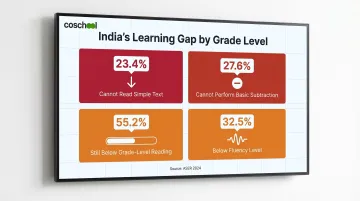
These aren't outliers — they represent the majority of learners in the system.
Personalized Learning as the Solution
Personalized learning is an instructional approach that creates individual pathways based on each student's strengths, gaps, interests, and learning pace. It doesn't mean students learn in isolation or that teachers become obsolete.
Technology handles what a single teacher facing 40 students cannot do alone:
- Adjusting content difficulty in real time based on each student's responses
- Identifying knowledge gaps before they compound into larger deficits
- Providing immediate support so no student quietly falls behind
This frees teachers to focus on what matters most: relationships, motivation, and the moments no algorithm can read. And today, the tools to make this work at India's scale already exist.
The Personalized Learning Technology Spectrum: From LMS to AI
Learning Management Systems (LMS)
An LMS is a digital platform designed to organize, distribute, and track learning content. It gives teachers a central hub to upload lessons, assign tasks, and monitor completion. Common examples include Moodle, Google Classroom, and Canvas.
What an LMS does:
- Centralizes teaching materials and assignments
- Tracks who has completed what and when
- Provides basic grade books and progress reports
- Enables communication between teachers and students
What an LMS does not do:
- Adjust content based on whether a student actually understood the material
- Identify knowledge gaps automatically
- Provide individualized learning paths
- Respond dynamically to student performance
ListEdTech tracks 9,658 LMS implementations across North America, with Canvas and Google Classroom each holding 28% market share. LMS adoption surged threefold during the pandemic — a pattern mirrored in India's own ed-tech expansion — establishing digital infrastructure. That infrastructure, however, doesn't personalize learning on its own.
Adaptive Learning Platforms
Adaptive platforms use algorithms and student performance data to adjust the sequence, difficulty, or format of learning content in real time. Unlike an LMS, adaptive platforms respond to each student's answers and patterns, creating a path shaped by each student's actual performance.
How they work:
- Track student responses, time spent, and error patterns
- Build a model of each student's current knowledge state
- Adjust what comes next based on that model
- Progress students when they demonstrate mastery, not simply because the calendar moved forward
Examples include Khan Academy's mastery system and DreamBox Learning's intelligent adaptive technology. Adaptive platforms are a significant step forward, but they still follow fixed rules. AI-powered platforms take the next step: they don't just adjust content, they interact.
AI-Powered Personalized Learning
The most advanced tier uses generative AI and machine learning to adapt content and interact with students conversationally. These platforms detect individual knowledge gaps, provide immediate contextual support, and engage students in genuine dialogue — replicating the experience of a personal tutor for every student in the classroom.
What AI adds:
- Natural language processing for actual conversation
- Ability to explain concepts in multiple ways
- Real-time detection of confusion and adjustment of approach
- Socratic questioning to build critical thinking
- Teacher dashboards with actionable insights on who needs help and why
Comparing the Three Tiers
Each tier differs significantly in how it delivers content, responds to student performance, and demands teacher time. The table below breaks down the key differences to help schools identify which model fits their current needs.
| Feature | LMS | Adaptive Learning | AI-Powered Learning |
|---|---|---|---|
| Content delivery | Fixed for all students | Adjusted by algorithm | Conversational and responsive |
| Response to performance | None (teacher must interpret data) | Automatic difficulty/sequence adjustment | Real-time dialogue and explanation |
| Teacher involvement | High (manual intervention for all personalization) | Moderate (teacher acts on platform insights) | Strategic (teacher focuses on high-value interactions) |
| Data generated | Completion rates, grades | Mastery levels, learning paths, gap identification | Interaction transcripts, comprehension signals, intervention flags |
| Implementation complexity | Low | Moderate | Moderate to high |
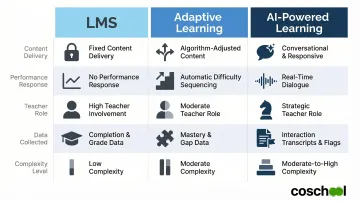
Most schools don't need to choose one tier permanently. Starting with LMS and layering in adaptive or AI capabilities as readiness grows is a practical path forward.
How Adaptive Learning Goes Beyond the Traditional LMS
The Core Mechanism: Formative Data in Action
Adaptive platforms use formative data — quiz answers, time spent on tasks, error patterns, strategy choices — to build a constantly updating model of each student's knowledge state. Rather than following a fixed linear curriculum, the platform adjusts what comes next based on what the student knows right now.
DreamBox Learning, for example, tracks not just whether a student gets the answer right, but which strategies they use to solve problems. It then immediately adjusts difficulty, scaffolding, sequencing, hints, and pacing. In a classroom of 25 students, DreamBox can create 25 different learning paths simultaneously.
Learner Profiles Replace Static Report Cards
Adaptive platforms build and continuously update profiles for each student — tracking mastery across concepts, identifying recurring gaps, and adjusting instruction paths. These profiles work very differently from report cards.
A report card says, "You got a B in math." A learner profile says, "You've mastered fractions but struggle with decimals; address place value before moving to percentages." One labels performance; the other directs what happens next.
Competency-Based Progression
In adaptive systems, students advance when they demonstrate mastery of a skill — not simply because the calendar moved to the next unit. Khan Academy's mastery system moves students through four tiers:
- Attempted — initial exposure to a concept
- Familiar — some correct responses, but inconsistent
- Proficient — consistent accuracy on standard problems
- Mastered — confirmed through spaced repetition challenges over time
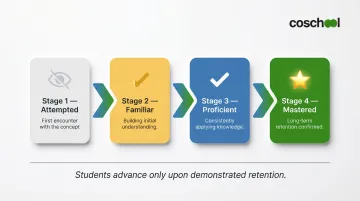
Students don't advance until they've demonstrated retention — not just short-term recall.
This prevents the accumulation of knowledge gaps. A student who hasn't mastered prerequisite skills doesn't advance to content that will only confuse them further.
The Teacher's Role in Adaptive Learning
Adaptive platforms don't replace teachers — they give them better information to act on. Platforms like DreamBox provide real-time dashboards that show exactly which students need intervention and why. In practice, this means teachers can:
- Identify struggling students before small gaps become big ones
- Plan targeted small-group sessions based on shared skill gaps
- Free up classroom time for meaningful 1:1 conversations
- Shift from delivering content to facilitating deeper learning
The Limitation That Motivates AI
Adaptive platforms are powerful, but they largely respond to structured inputs — multiple-choice responses, task completion rates, pattern detection in closed exercises. When a student asks "But why does this work?" — or needs a concept explained three different ways before it clicks — adaptive systems reach their limit. That gap is precisely what conversational AI is built to fill: open-ended explanation, on-demand clarification, and support that adapts to how a student thinks, not just what they answer.
AI-Powered Personalized Learning: True 1:1 at Scale
How Generative AI Changes the Equation
Unlike rule-based adaptive systems, AI-powered platforms use natural language processing and generative models to engage students in actual dialogue. They answer questions, explain concepts in multiple ways, and adjust in real time to the student's responses. This brings the experience of a personal tutor to every student, simultaneously.
Benjamin Bloom's foundational 1984 research found that 1:1 tutoring combined with mastery learning produced a 2 standard deviation improvement — meaning the average tutored student outperformed 98% of conventionally taught peers. This became known as the "two sigma problem": finding scalable methods that approximate that tutoring effect. AI-powered learning is the first technology capable of approaching it.
Conversational Learning as a Modality
Learning through conversation is one of the most natural and effective ways humans acquire knowledge. Socratic questioning — probing a student's understanding through guided questions — forces students to articulate their reasoning, identify gaps in their logic, and arrive at conclusions independently. AI tutors that engage students in back-and-forth dialogue, ask follow-up questions, detect confusion, and rephrase explanations go beyond content delivery into genuine comprehension support.
A 2025 systematic review of 28 studies involving 4,597 K-12 students found that intelligent tutoring systems produced effect sizes of g = 0.68 to d = 1.30 compared to traditional instruction — meaningful improvements translating to moving students from the 50th percentile to the 75th-85th percentile.
AI Empowers Teachers, Not Replaces Them
AI-powered platforms handle repetitive instructional support, flag students who need attention, and provide teachers with real-time insights. Teachers focus on relationship-building, motivation, creative facilitation, and the kinds of nuanced support no algorithm can replicate.
In the US, RAND Corporation found that 53% of teachers now use AI for school — primarily for lesson planning, grading, and feedback. The challenge is ensuring AI complements teaching, not substitutes for it.
Coschool: An AI-First Example
Coschool's SchoolAI platform is designed around exactly that balance — AI doing the repetitive instructional work while teachers focus on what matters most. Drawing on 30 years in education, Coschool uses Generative AI to create 1:1 learning experiences through Vin, an AI tutor that engages students in guided, Socratic dialogue. Rather than simply providing answers, Vin asks follow-up questions, detects confusion, and adjusts explanations in real time.
The platform operates through a closed-loop system:
- Teachers assign homework through SchoolAI
- Vin guides students during homework and self-study with personalized, real-time feedback
- Vin shares actionable insights on student performance with teachers
- Teachers implement student-specific interventions to close gaps
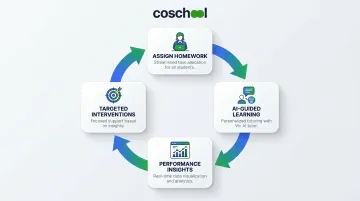
Schools using SchoolAI have achieved 8-12% increases in class averages — evidence that timely, personalized support produces measurable gains.
Parent Partnership Dimension
The most advanced personalized learning platforms also bridge home and school, giving parents visibility into their child's progress and identifying where support is needed at home. A peer-reviewed study found that parental involvement positively impacts academic outcomes by 42.1%. Platforms that provide real-time insights and direct communication channels turn parents into active participants rather than passive observers.
Real Benefits of Personalized Learning Solutions for Schools
Student Outcomes
Personalized learning — particularly adaptive and AI-powered forms — reduces knowledge gaps, improves mastery rates, and increases student engagement by making learning feel relevant and achievable. The Ma et al. meta-analysis of 107 effect sizes involving 14,321 participants found that intelligent tutoring systems produced g = 0.42 improvement over teacher-led large-group instruction — roughly moving an average student from the 50th to the 66th percentile.
Teacher Effectiveness and Satisfaction
Teachers armed with real-time student data and AI-assisted content tools spend less time on administrative tasks and more time on the human dimensions of teaching. This is especially important in India's high pupil-teacher-ratio environments. UDISE+ 2022-23 data shows India's national pupil-teacher ratio reaches 23:1 at secondary level and as high as 62:1 in Bihar. In these contexts, technology-mediated personalization is a structural necessity, not an optional add-on.

Institutional Value
These individual gains compound into school-level value. Personalized learning platforms give administrators longitudinal data on student progress, making it possible to act early — before gaps widen. Schools can use this data to:
- Identify which subjects or grade levels need additional support
- Track cohort performance across academic years
- Direct professional development where it will have the most impact
- Demonstrate measurable outcomes to parents and school boards
How to Choose the Right Personalized Learning Solution for Your School
Map the Solution to Your School's Stage
Schools just starting digitization benefit most from a structured LMS — establishing basic infrastructure for content delivery and tracking before adding adaptive layers.
The next step is platforms with adaptive capabilities: real-time progress monitoring, learner profiling, competency-based content sequencing, and teacher dashboards that translate data into action.
Schools aiming for genuine personalization at scale should evaluate AI-first platforms that enable conversational learning, provide real-time gap identification, and equip teachers with actionable insights.
Key Evaluation Criteria
Depth of personalization: Does the platform simply deliver content, adjust difficulty algorithmically, or engage students conversationally with nuanced support?
Ease of use for teachers: Does it reduce administrative burden or add to it? Does it provide actionable insights, not just raw data?
Quality of data and reporting: Can teachers and administrators quickly identify who needs help, on what, and why? Are insights timely enough to act on?
Curriculum alignment: Look for support across CBSE, ICSE, and state board standards, as well as coverage of your specific grade levels and subject areas.
Home-school bridge: Does it keep parents informed and engaged, or leave them in the dark?
Why a Comprehensive Solution Matters
The most effective personalized learning implementations involve all stakeholders — teachers, students, and parents. A solution that empowers teachers with tools, supports students with adaptive or AI-driven learning, and keeps parents informed creates a connected ecosystem where everyone works toward the same goal.
Coschool's integrated approach demonstrates this in practice. Teachers get AI-assisted lesson planning and actionable insights; students work with Vin, the AI tutor, for 1:1 conversational support; and parents receive real-time progress updates. Learning gaps get identified and addressed before they compound.
Frequently Asked Questions
What is an example of an adaptive learning platform?
Khan Academy and DreamBox Learning are both adaptive platforms. Khan Academy adjusts content difficulty and uses spaced repetition to ensure long-term retention; DreamBox tracks problem-solving strategies and immediately adjusts scaffolding, sequencing, and hints based on student performance, creating a unique learning path for each student.
What is the difference between an LMS and adaptive learning?
An LMS organizes and delivers fixed content to all students the same way, tracking completion and grades. An adaptive learning platform adjusts what each student sees next based on their performance data, creating a responsive, individualized experience rather than a single fixed pathway.
What is the difference between an IEP and an ILP?
An IEP (Individualized Education Program) is a legally mandated disability support plan originating in U.S. policy; in India, similar provisions exist under the Rights of Persons with Disabilities Act 2016. An ILP (Individual Learning Plan) is a broader goal-setting tool used in personalized learning for any student to map their learning path and track progress toward goals.
How does AI personalize learning for each student?
AI uses natural language processing and machine learning to interact with students conversationally, detect understanding gaps in real time, and adjust explanations based on each response. This allows AI to build evolving learner profiles and deliver genuinely responsive, tutor-like support that rule-based systems cannot match.
Can personalized learning work in large classrooms?
Yes. AI-powered platforms are built precisely for this challenge. They automate adaptive support and real-time feedback for each student while giving teachers targeted data on who needs intervention, making genuine 1:1 support feasible even in classrooms of 30 or more.