The traditional one-size-fits-all model fails most students because it ignores a fundamental truth: readiness, interest, and learning style vary widely within every classroom. This is where differentiated instruction steps in—a teaching philosophy that adapts what is taught, how it's taught, and how learning is assessed to meet each student where they are, all while keeping the same core learning goal for everyone.
This guide walks you through everything you need to know: the definition, the four elements of differentiated instruction, practical strategies you can use tomorrow, a real lesson plan example, and how technology is making differentiated instruction scalable even in large classrooms.
TLDR
- Differentiated instruction tailors teaching methods, materials, and assessments to student readiness, interests, and learning profiles while maintaining common learning goals.
- Teachers modify four elements: content, process, product, and learning environment — each adjusted to meet students where they are.
- Practical strategies include flexible grouping, tiered assignments, ongoing formative assessment, interest-based learning, and scaffolding.
- AI-powered platforms like Coschool make differentiation practical in large classrooms — automating content adaptation, tracking individual gaps in real time, and surfacing insights that help teachers act fast.
What Is Differentiated Instruction?
Differentiated instruction (DI) is a teaching approach where teachers proactively adjust curriculum, delivery methods, and assessments based on student readiness, interests, and learning profiles—while keeping the same core learning goal for everyone.
Carol Ann Tomlinson, whose foundational work established the modern DI framework, describes differentiation not as a single strategy or recipe, but as "a way of thinking about teaching and learning" that balances attention to individual students and course content. Unlike individualised instruction—which adjusts pace and curriculum per student—or personalised learning—which gives students unique paths—DI sits between whole-group teaching and fully customised instruction.
Research supports its effectiveness. Research backs its effectiveness. A meta-analysis of 21 studies found small but consistent positive effects on primary students' language and maths outcomes. A separate Grade 3 science study found a large effect favouring DI classrooms, with students also showing higher motivation and cooperation.
DI benefits every type of learner in a mixed classroom:
- Struggling students receive targeted support before gaps widen
- On-track learners stay engaged with appropriately paced content
- Gifted students get meaningful challenges rather than repetition
- Students with learning differences (such as dyslexia or ADHD) gain access to the curriculum through approaches that match how they process information
The 4 Elements of Differentiated Instruction
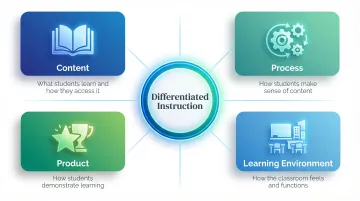
Teachers differentiate through four key elements: Content, Process, Product, and Learning Environment. Each element can be adjusted based on where a student is academically, what they're curious about, and how they learn best.
Content
Content differentiation adapts what students learn or how they access information. The learning objective stays the same, but complexity, format, or resources change.
Examples:
- Providing reading materials at different difficulty levels (illustrated texts for struggling readers, standard passages for grade-level learners, extended case studies for advanced students)
- Presenting the same concept through visual diagrams and auditory explanations
- Using reading buddies to support struggling learners while others read independently
Process
Process differentiation focuses on how students make sense of what they're learning—the activities and methods used to internalise content.
Examples:
- Tiered activities where all groups work toward the same concept but at different levels of challenge (one group uses manipulatives, another solves standard problems, and a third tackles word-problem extensions)
- Interest centres that allow students to explore subtopics aligned with their curiosity
- Flexible group work with varying levels of teacher support or peer collaboration
- Graphic organisers and guided prompts for students who need structured thinking aids
Product
Product differentiation gives students choice in how they demonstrate what they've learned, recognising that a written test may not capture every student's understanding.
Examples:
- Allowing students to choose between a verbal explanation, visual poster, written report, or short video to show mastery
- Using rubrics with tiered success criteria that reflect varying skill levels
- Choice boards (like Tic-Tac-Toe grids) where students select from multiple options to demonstrate learning
Learning Environment
The learning environment covers how the classroom feels and functions—physical setup, classroom norms, and routines.
Examples:
- Alternative seating (flexible chairs, standing desks, floor cushions) to accommodate different work preferences
- Quiet corners for focused work and collaborative zones for group projects
- Culturally inclusive materials representing diverse student backgrounds
- Guidelines that allow students to seek peer help independently when the teacher is occupied
Practical Strategies for Differentiating Instruction
Flexible Grouping
Students are not locked into fixed ability groups. Instead, they rotate across different groupings—pairs, small groups, or one-on-one with the teacher—based on the task and their current needs. This avoids labeling effects and encourages peer learning. Research shows that streaming or ability tracking creates a "glass ceiling" for lower groups, while mixed-ability grouping enables mentoring.
Tiered Assignments
All students work toward the same learning goal, but the level of complexity, support, or depth varies. For example, in a maths lesson on fractions:
- Group 1 uses fraction bars and visual models
- Group 2 solves standard fraction problems
- Group 3 tackles multi-step word problems requiring fraction operations
Ongoing Formative Assessment
Teachers cannot differentiate without knowing where students are. Formative assessment is the engine of DI. Practical, low-effort methods include:
- Exit tickets (quick end-of-lesson checks)
- Thumbs up/down or traffic light self-rating
- Short pre-assessment quizzes before starting a unit
- Student self-rating on a 1–5 confidence scale
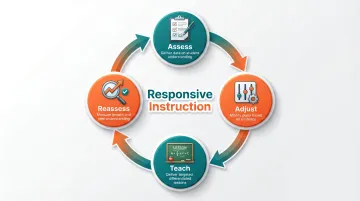
This feeds a continuous cycle — assess, adjust, teach, then assess again — that keeps instruction responsive rather than fixed.
Interest-Based Learning
Allowing students some choice in topics they explore or how they engage with content increases motivation. Examples include:
- Choice boards that let students select from multiple activities
- Passion projects within a unit (e.g., students research an ecosystem of personal interest during a science unit on habitats)
Scaffolding and Anchor Activities
Choice and motivation address the "why" of learning — but students also need different levels of structural support to get there. That's where scaffolding and anchor activities come in.
Scaffolding gives struggling learners temporary structured support: graphic organisers, sentence starters, step-by-step guides, or teacher prompts. As students gain competence, teachers gradually remove those supports.
Anchor activities keep advanced learners productively engaged while the teacher works with another group — independent tasks like additional reading, research projects, or creative applications that extend the same content.
Differentiated Instruction in a Lesson Plan: A Step-by-Step Example
Here's how differentiated instruction plays out in a Class 8 Science lesson on ecosystems — mapped across a standard 45-minute period.
Learning Goal (Same for All Students): Understand the flow of energy in an ecosystem and identify producers, consumers, and decomposers.
Content Differentiation
The teacher prepares three versions of the core concept:
- Struggling learners receive a short illustrated explainer with labelled diagrams showing energy flow: sun → plants → herbivores → carnivores → decomposers
- Grade-level learners read a standard textbook passage on food chains and food webs
- Advanced learners work through a data-based case study on energy loss at each trophic level (the 10% rule), including charts on transfer efficiency
Process Differentiation
Once students have their materials, the teacher groups them flexibly based on a quick pre-assessment.
- Group 1 (needs support) works through a guided worksheet with sentence starters and prompts ("Producers get energy from _____. An example is _____."), with regular teacher check-ins
- Group 2 (on track) discusses in pairs using structured questions, then builds a concept map together
- Group 3 (advanced) tackles an independent inquiry: "Why are there fewer carnivores than herbivores in most ecosystems? Use the 10% rule to explain."
Product Differentiation
At the end of the lesson, students choose how to demonstrate their understanding:
- Draw and label a food web showing energy flow
- Write a short paragraph on what would happen if decomposers disappeared
- Create a mind map connecting the roles of producers, consumers, and decomposers
All three products are evaluated against a common rubric with tiered success criteria (basic, proficient, advanced). This ensures every student is held to the same learning goal — just supported along different paths to reach it.
Why Differentiated Instruction Matters
Differentiated instruction tackles a fundamental flaw in traditional whole-class instruction: lessons pitched to the "average" student routinely fail two-thirds of the class. As Lilian Katz observed, when teachers pitch content to the "average" student, one-third already know it, one-third will learn it, and one-third won't—meaning two-thirds waste their time in every lesson.
Equity and Inclusion
DI promotes inclusion by ensuring students with learning differences, English language learners, and gifted students all receive appropriately challenging work. Research shows that differentiated practices improve motivation, comprehension, and participation, helping reduce achievement gaps over time.
Teacher Effectiveness
Better student outcomes start with better teacher insight. DI gives teachers clearer visibility into individual progress through ongoing assessment, making instruction more targeted. Instead of repeating the same lesson regardless of who needs what, teachers can focus their effort precisely where it matters most.
Common Challenges — and How Technology Is Changing the Game
Teachers face real barriers to implementing differentiated instruction: large class sizes (India's student-teacher ratios are 27.2 in primary and 21.4 in upper secondary), limited planning time, difficulty tracking individual student progress in real time, and the cognitive load of preparing multiple versions of content. These are genuine concerns, not excuses.
How AI Is Supporting DI at Scale
AI-powered tools are increasingly used to support differentiated instruction by automating content levelling, tracking learning gaps in real time, and suggesting adaptive next steps for each student. UNESCO's 2023 Global Education Monitoring Report emphasises that "digital technology should complement, not substitute" teachers—a principle that shapes how effective platforms are designed and deployed.
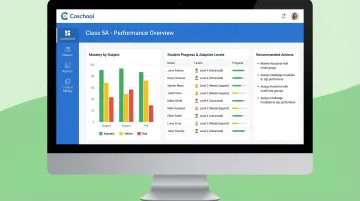
Platforms like Coschool use Generative AI to help teachers implement personalised, adaptive learning at scale. The platform provides customisable classroom resources, generates tiered content, and delivers actionable insights on student performance — enabling a closer-to-1:1 learning experience without multiplying the teacher's planning burden.
Schools using Coschool's platform have reported 8–12% increases in class averages, demonstrating that technology can support differentiation effectively when teacher-led and well-implemented.
Teachers still make the key instructional decisions — they build relationships, read the room, and provide the human connection no algorithm can replicate. The real value of these tools is the time they return: more space for real-time feedback, meaningful group discussions, and the kind of individual attention that makes differentiated instruction work.
Frequently Asked Questions
What is the meaning of differentiated instruction?
Differentiated instruction is a teaching approach where instruction is tailored to students' readiness, interests, and learning profiles, while maintaining the same learning goals for all students. It contrasts with the traditional one-size-fits-all model by recognising that students learn at different paces and in different ways.
What are the 4 elements of differentiated instruction?
The four elements are Content (what students learn and how they access it), Process (how students make sense of content through activities), Product (how students demonstrate learning), and Learning Environment (how the classroom feels and functions, including setup, norms, and culture).
What are the 4 types of differentiated instruction?
The "4 types" is another way to describe the same four elements—Content, Process, Product, and Learning Environment—from Carol Ann Tomlinson's framework. In practice, the terminology varies across schools and curricula, but the underlying dimensions remain consistent. Think of each as a different lever a teacher can adjust to meet diverse student needs.
What is an example of differentiated instruction in a lesson plan?
In a reading lesson, one group reads an illustrated version of a text, another reads the standard version, and a third reads an extended version with complex vocabulary. All groups then respond to the same core comprehension questions, but the questions are tiered by complexity to match each group's reading level.
What are the 3 P's of differentiation?
The 3 P's refer to Process, Product, and Profile—the three most commonly adjusted dimensions in differentiated instruction. They represent how students work through content, how they demonstrate understanding, and the individual traits (readiness, interest, learning style) that shape both.
What is the 70/30 rule in teaching?
The 70/30 rule suggests that students should be actively engaged or doing the learning roughly 70% of the time, while teacher-led instruction accounts for about 30%. This principle aligns with differentiated instruction's philosophy of student-centred, active learning rather than passive listening.
Differentiated instruction is a commitment to ensuring every student has access to meaningful learning. By adjusting content, process, product, and environment around student readiness, interest, and learning profile, teachers create classrooms where every learner is both supported and appropriately challenged. With AI-powered tools that reduce planning burden and surface real-time insights, that commitment is becoming more practical—even in India's large, diverse classrooms.