Introduction
India's school education system serves a staggering 24.8 crore students across 14.72 lakh schools, yet many classrooms struggle with severe learning gaps. Only 44.8% of Class V government school students can read a Class II level text, and just 30.7% of Class V students nationwide can perform division, according to ASER 2024 findings. Behind these numbers are teachers managing oversized classrooms, students quietly falling behind, and parents with little visibility into what's happening in school.
The right EdTech platform can address all three at once. Not all EdTech solutions are built for schools, though. Many platforms target individual learners rather than the interconnected needs of teachers, administrators, and school systems as a whole.
This comparison focuses exclusively on platforms designed specifically for schools: tools that empower teachers, personalise student learning, and bring parents into the picture. Each entry was evaluated on institutional fit, not just consumer appeal.
Key Takeaways
- Most Indian EdTech platforms target consumers. Only a handful are purpose-built for school ecosystems
- Top platforms combine AI-driven adaptive learning, CBSE/state board alignment, and actionable teacher analytics
- Key criteria: deployment ease, teacher tools, student personalisation, parent communication, and clear pricing
- This list covers platforms from AI-first newcomers like Coschool to established names like Extramarks and Next Education
Why Schools in India Need Dedicated EdTech Platforms
Consumer EdTech apps, designed for individual learners and parents, focus on video lessons, practice tests, and subscription models. Institutional EdTech platforms serve a fundamentally different purpose: they integrate into school operations with teacher dashboards, curriculum-mapped content, student performance tracking, and school administration tools.
The scale of India's classroom challenge makes this distinction critical. India's pupil-teacher ratio varies significantly by level: 10 students per teacher at foundational level, rising to 21 at secondary. In reality, 1,10,971 schools operate with a single teacher, and 66.6% of primary classrooms are multigrade.
Teachers already juggle multiple grades and subjects simultaneously. Without the right tools, personalised attention for each student remains out of reach.
A school-grade EdTech platform delivers:
- Curriculum-mapped content aligned to CBSE, ICSE, or state boards
- Teacher dashboards that surface clear insights on student performance
- Real-time student tracking identifying learning gaps before they widen
- Parent engagement tools extending learning from classroom to home
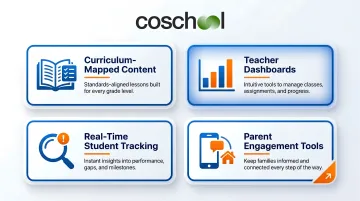
The right platform gives every teacher the visibility and resources to support each student, even across mixed-grade, high-ratio classrooms.
Top 10 EdTech Platforms for Schools in India
We selected these platforms based on school deployment readiness, AI and adaptive learning capabilities, curriculum alignment, teacher empowerment features, and breadth of school-focused functionality.
Coschool
Coschool is the parent company behind SchoolAi, an AI-first, closed-loop learning platform for schools, backed by over 30 years of education institution-building experience through People Combine Group. Its mission: empower teachers and ensure no student is left behind. The platform is anchored by Vin, India's first school-integrated AI tutor, which guides students through learning using the Socratic method, never giving away answers.
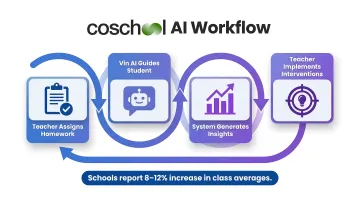
SchoolAi by Coschool connects every stakeholder through a closed-loop workflow:
- Teachers assign homework
- Vin guides students through completion with personalised explanations
- The system generates actionable insights for teachers
- Teachers implement targeted interventions in one click
Schools using SchoolAi by Coschool have documented 8-11% increases in class averages.
The platform bridges the home-school divide with parent engagement dashboards that deliver real-time insights into student progress, empowering parents to support learning at home.
| Aspect | Details |
|---|---|
| Key Features | AI-powered personalised learning, school-integrated AI tutor (Vin), teacher classroom tools, parent engagement dashboards, real-time performance insights |
| Best For | Schools seeking an AI-first solution that simultaneously empowers teachers, personalises student learning, and connects parents to the learning journey |
| Pricing Model | Contact Coschool for institutional pricing; purpose-built for private schools with fee structures typically above ₹20,000/year |
Extramarks
Extramarks pioneered school digitalisation in India since 2007, now serving over 21,000 schools. The platform offers curriculum-mapped digital content, smart class infrastructure, and the School Integrated Program (SIP) for JEE/NEET preparation within campuses.
Its unique DLPTE pedagogy (Diagnose, Learn, Practice, Test, Evaluate) structures learning systematically. Rich 2D/3D animated content brings concepts to life, while AI-based performance reports track student progress. The Teaching App gives educators access to vast question banks and content repositories.
The content-plus-infrastructure combination makes Extramarks a practical choice for schools seeking proven large-scale deployment with robust digital classroom capabilities.
| Aspect | Details |
|---|---|
| Key Features | Smart class infrastructure, animated curriculum content (K-12), AI performance analytics, teacher app with content repository, mock tests and assessments |
| Best For | Schools looking for a comprehensive content-plus-infrastructure solution with proven large-scale deployment |
| Pricing Model | Contact Extramarks for institutional pricing or licensing model |
BYJU'S for Schools
BYJU'S is India's most recognised EdTech brand, offering K-12 personalised learning through animated video lessons, adaptive practice, and live classes. The BYJU'S School program extends this to institutional deployments.
The platform covers multiple curricula (CBSE, ICSE, state boards) and integrates competitive exam preparation for JEE and NEET.
That said, schools should verify current service status before committing. India's Supreme Court revived insolvency proceedings against BYJU'S in August 2024 following payment defaults. Confirm active institutional program availability directly with the provider.
| Aspect | Details |
|---|---|
| Key Features | Adaptive learning app, animated video content, live classes, competitive exam prep resources, multi-board curriculum support |
| Best For | Schools wanting high-quality animated content and a recognisable brand that students are already familiar with |
| Pricing Model | Contact BYJU'S or Aakash BYJU'S Digital for current institutional pricing |
Next Education
Next Education, founded in 2007 and headquartered in Hyderabad, serves 18,000+ partner schools across India. Its product suite includes TeachNext, LearnNext, NextLabs (Maths, Science, English), and NextERP, built on open-source software with multi-language support.
The platform emphasises interactive classroom tools with IR remote-enabled engagement, 2D/3D graphics, and voice-over-driven learning. This makes it particularly suitable for schools in Tier II/III cities or state board schools needing vernacular-language digital content.
| Aspect | Details |
|---|---|
| Key Features | Digital classroom tools (TeachNext/LearnNext), subject-specific labs, multi-language content, curriculum support for multiple state boards, interactive classroom hardware |
| Best For | Schools in Tier II/III cities or state board schools needing vernacular-language digital content |
| Pricing Model | Contact Next Education for institutional pricing or partnership model |
LEAD School
LEAD School offers an integrated school EdTech solution providing a complete package: digital content, live classes, teacher training, and analytics. The platform is designed to improve school infrastructure and student outcomes holistically for K-12.
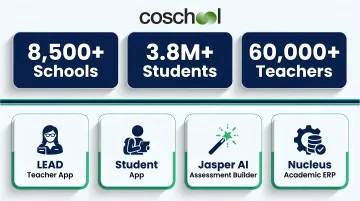
LEAD's approach is distinctive. It works directly with school management to improve teaching quality across entire school networks. Serving 8,500+ schools, 3.8M+ students, and 60,000+ teachers across 400+ cities, LEAD functions as a full school transformation platform. Its components include the LEAD Teacher App, Student App, Jasper (AI assessment builder), and Nucleus academic ERP.
| Aspect | Details |
|---|---|
| Key Features | Integrated LMS, live classes, teacher training programs, performance analytics, school management tools |
| Best For | Budget and mid-range private schools looking for end-to-end school system transformation |
| Pricing Model | Contact LEAD School for per-student or school-level subscription pricing |
Embibe
Embibe is an AI-powered learning platform using advanced machine learning to identify student learning gaps, deliver personalised content recommendations, and improve performance in school exams and competitive entrance tests. Reliance Industries announced a strategic investment of up to USD 180 million in the platform in 2018.
Embibe's differentiation lies in deep data analytics; its proprietary AI goes beyond content delivery to understand the "why" behind student errors. School-facing dashboards provide teacher-level insights for targeted instruction. Schools should independently verify current service levels before procurement, as recent reporting points to operational challenges at the platform.
| Aspect | Details |
|---|---|
| Key Features | AI-driven gap analysis, personalised content recommendations, student performance analytics, school dashboards, mock tests |
| Best For | Schools that prioritise data-driven, outcome-focused learning and want AI to guide teaching strategy |
| Pricing Model | Contact Embibe for school/institutional pricing |
Vedantu
Vedantu, founded in 2011, is a live online tutoring platform serving K-12 students with real-time teacher-student interaction via its WAVE technology (Whiteboard Audio Video Environment). The platform now offers school-connect programs for institutional integration.
Live doubt resolution, subject specialist teachers, and scheduling flexibility are where Vedantu stands out. It's particularly useful for schools wanting to supplement classroom learning with expert-led live sessions, especially for grades 6-12 where competitive exam preparation and subject-specific expertise become critical.
| Aspect | Details |
|---|---|
| Key Features | Live online classes, real-time doubt resolution, whiteboard-based interactive sessions, K-12 subject coverage, performance tracking |
| Best For | Schools seeking live expert tutoring to supplement in-school instruction, especially for grades 6-12 |
| Pricing Model | Contact Vedantu for school connect or institutional plan pricing |
Teachmint
Teachmint is a teacher-first, mobile-based platform helping schools digitise classroom operations. With 20M+ users across 50+ countries, it enables live classes, attendance tracking, fee management, content sharing, and communication, all from a single interface.
Low technical overhead and a mobile-first design make Teachmint easy to adopt for both individual teachers and school admins, a practical fit for schools in the early stages of digital transformation. The platform is available in 17 languages and is ISO 27001 certified for security, addressing privacy concerns critical for schools.
| Aspect | Details |
|---|---|
| Key Features | Live class hosting, attendance and fee management, content library, school admin tools, mobile-first design |
| Best For | Schools at the beginning of their digital adoption journey needing simple, low-cost operational tools |
| Pricing Model | Contact Teachmint for freemium or subscription pricing |
Khan Academy
Khan Academy is a globally trusted non-profit platform offering free, world-class K-12 content across maths, science, computing, and humanities. Available in multiple languages including English, Hindi, Gujarati, Assamese, Odia, Marathi, Punjabi, and Kannada, it's widely used as a supplementary resource in Indian schools.
Its zero-cost model, teacher dashboards, and student progress tracking make it ideal for schools needing supplementary learning resources without procurement hurdles. However, curriculum mapping is limited: English maths content is mapped to India Class 5-12, but alignment to CBSE/NCERT for other subjects varies.
| Aspect | Details |
|---|---|
| Key Features | Free K-12 content library, practice exercises, instructional videos, teacher and student dashboards, multi-language support |
| Best For | Schools needing a zero-cost supplementary learning resource, especially for maths and science reinforcement |
| Pricing Model | Completely free for students and teachers; sustained by donations |
iDream Education
iDream Education serves underserved and rural school communities through tablets, mobile apps, and multilingual digital content. With 25,000+ classrooms digitalised and 15 lakh+ students across 23 states, the platform is designed to bring quality education to government and low-income private schools.
iDream's focus on inclusion, offline-capable content delivery for low-connectivity environments, and personalised adaptive learning make it a strong choice for schools in Tier III cities, rural areas, or government school networks. The platform has been recognised as an ideal partner for PM SHRI implementation.
| Aspect | Details |
|---|---|
| Key Features | Multilingual digital content, offline-capable learning, tablet and mobile app delivery, adaptive learning, government school compatibility |
| Best For | Government schools, rural schools, and NGO-managed institutions serving students in low-connectivity areas |
| Pricing Model | Contact iDream Education for institutional or government partnership pricing |
How We Chose These EdTech Platforms for Schools in India
Every platform on this list was evaluated for school-specific deployment, not individual student use. Our criteria covered teacher tool quality, curriculum alignment with Indian boards (CBSE, ICSE, and state boards), student personalisation capabilities, and evidence of institutional adoption at scale.
Common Selection Mistakes to Avoid
School decision-makers often make these errors:
- Picking a popular student app over a purpose-built school solution
- Selecting sophisticated platforms that teachers won't realistically adopt
- Overlooking parent engagement features that reinforce learning at home
- Evaluating price alone without considering ROI in student outcomes
Avoiding these mistakes is only half the equation. Choosing the right platform ultimately comes down to your school's specific context.
Context Matters More Than Brand
The best platform for your school isn't necessarily the most popular one. Consider:
- Schools under 500 students need different solutions than institutions with 2,000+
- CBSE, ICSE, and state boards each carry distinct content requirements
- AI tools deliver no value if teachers lack the training or confidence to use them
- Pricing should align with long-term sustainability, not just what's affordable today
- Your priority matters: content delivery, teacher empowerment, and full school transformation each call for different tools
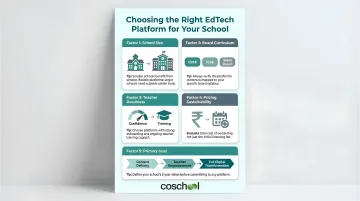
A platform perfectly suited for a 2,000-student CBSE school in Hyderabad may be entirely wrong for a 300-student state board school in rural Maharashtra.
Conclusion
Not all EdTech platforms are built the same, and this comparison makes that clear. The strongest contenders go beyond content delivery, pairing adaptive learning with teacher tools and parent visibility that schools can actually act on.
School decision-makers should evaluate platforms against specific goals rather than brand reputation. If your priority is closing learning gaps while empowering teachers and engaging parents, an AI-first platform like SchoolAi by Coschool, purpose-built for the school ecosystem, is worth exploring. Visit coschool.ai to learn more.
Frequently Asked Questions
Which is the best EdTech platform for schools in India?
There is no single "best" platform. The right choice depends on your school's board affiliation, budget, and goals (content delivery vs. AI-driven personalisation vs. school management). SchoolAi by Coschool is a strong AI-first option for schools seeking personalised learning, with schools reporting 8-11% improvements in class averages after deployment.
What features should schools look for in an EdTech platform?
Look for these core criteria:
- Curriculum alignment with CBSE or relevant state boards
- Teacher-facing dashboards and resource tools
- Adaptive or personalised student learning
- Parent communication features
- Ease of deployment and onboarding
- Data privacy compliance with India's Digital Personal Data Protection Act, 2023
How much do EdTech platforms for schools in India typically cost?
Pricing varies widely, from free (Khan Academy) to per-student annual licensing fees ranging from ₹500 to ₹5,000+ depending on features and scale. Schools should request demos and evaluate ROI in terms of improved student outcomes, not just cost per student.
Are these EdTech platforms compatible with CBSE and state board curricula?
Most established platforms like Extramarks and Next Education support CBSE, ICSE, and multiple state boards. AI-first platforms like SchoolAi by Coschool focus on adaptive learning regardless of board, personalising within curriculum boundaries.
How do AI-powered EdTech platforms benefit school students?
AI-powered platforms identify learning gaps in real time, personalise learning pathways for each student, and reduce dependence on one-size-fits-all instruction. This delivers individualised support across large classrooms, something traditional teaching alone cannot scale to.
What is the difference between an EdTech platform for individual students and one designed for schools?
Consumer apps are student-facing, subscription-based, and lack school management features. Institutional platforms are built for school deployment with teacher tools, admin dashboards, curriculum alignment, and multi-user licensing that fits into existing school operations.