Introduction
Picture this: a classroom with 35 students. Some grasp fractions in minutes while others struggle with basic numeracy. One student thrives with visual aids, another learns best through conversation. Yet the lesson moves forward at a single pace, leaving some bored and others confused.
This tension defines modern education. In India, 65% of high schools have adopted personalized learning plans, with an estimated 45% of all high school students now having one. Yet most classrooms still operate on industrial-age assembly-line models—same content, same pace, same assessments—despite decades of research showing we learn differently.
What if every student could learn in the way that works best for them—as everyday reality, not just an aspiration? This article covers what personalized learning actually is, how it differs from similar approaches, its core elements, proven implementation models, documented benefits and challenges, and how AI is making true 1:1 personalization achievable in India's large classrooms.
TLDR
- Personalized learning tailors content, pacing, and methods to each student's strengths, needs, and interests—not just teacher-adjusted group instruction
- Students actively drive their own learning, unlike differentiated or individualized instruction where teachers control decisions
- Real-world models include learner profiles, personal learning paths, competency-based progression, and flexible environments
- RAND research shows 0.27 effect size in math (11 percentile points) and 0.19 in reading (8 percentile points), with lowest-performing students benefiting most
- AI tools now provide real-time adaptive learning, instant gap detection, and actionable insights, making 1:1 support scalable even in large classrooms
What Is Personalized Learning—And How Is It Different from Differentiated Learning?
Personalized learning is an educational approach where each student's learning plan reflects their individual strengths, needs, pace, and interests. Education researchers widely define it as instruction where "the pace of learning and instructional approach are optimized for each learner"—with learning objectives, methods, and content all varying by student.
This is not a single tool or curriculum. It's a framework where the system adapts to the learner, not the other way around.
The PDI Distinction: Three Commonly Confused Terms
The clearest distinction comes from the Bray and McClaskey PDI framework (2013), one of the most widely cited models in education:
| Dimension | Differentiated Instruction | Individualized Instruction | Personalized Learning |
|---|---|---|---|
| Who drives learning | The teacher | The teacher | The learner |
| Focus | Groups of learners | Individual learner needs | Interests, passions, aspirations |
| Assessment type | Assessment FOR learning | Assessment OF learning | Assessment AS learning |
| Pacing | Synchronized with grade-level peers | Adjusted for individual | Self-directed, flexible |
| Student agency | Limited—teacher selects resources | Low—teacher selects technology | High—learner co-designs curriculum |
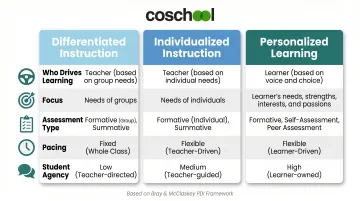
In personalized learning, students drive their own learning, act as co-designers of curriculum, and create personal learning plans. In differentiation and individualization, the teacher remains the primary decision-maker.
Differentiated learning adjusts how content is delivered to different groups in the same classroom. Everyone aims for the same goal — only the path varies.
Individualized learning lets students progress at different speeds, but the teacher still controls what is learned and when.
Personalized learning goes further: goals, content, pace, and method can all vary. Students have an active voice in shaping their own learning experience.
What Personalized Learning Is NOT
Personalized learning is not a replacement for special education, IEPs, or 504 plans—it works alongside them. A Personalized Learning Plan (PLP) is a voluntary school-initiated tool; an IEP is a legally mandated document for students with disabilities. They can complement each other.
It's also not simply giving students screen time or letting them choose topics arbitrarily. Teacher guidance remains central. The goal is structured student agency, not unstructured choice.
Key Elements of Personalized Learning
RAND Corporation's Four Core Strategies
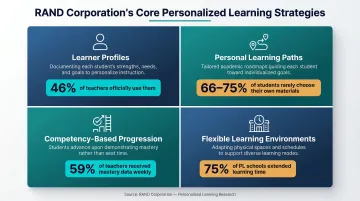
Research funded by the Gates Foundation across 62 schools identifies four interdependent strategies that define personalized learning implementation:
| Strategy | What It Means | RAND Finding |
|---|---|---|
| Learner Profiles | Real-time records of strengths, challenges, goals | 46% of teachers officially use them |
| Personal Learning Paths | Meaningful material choices with adult support | 66–75% of students rarely or never choose their own materials |
| Competency-Based Progression | Students advance by demonstrating mastery, not seat time | 59% of teachers received mastery data weekly |
| Flexible Learning Environments | Schools reallocate space, staff, and time fluidly | 75% of PL schools extended learning time |
Learner Profiles
Rich, frequently updated records track each student's strengths, challenges, motivations, and goals. Unlike report cards updated twice a year, learner profiles evolve in real time—giving teachers early signals to adjust strategies before students fall behind.
Personal Learning Paths
Students may combine project-based group work, independent skill practice, and one-on-one teacher time. However, RAND found two-thirds to three-quarters of students reported they "sometimes, rarely, or never" chose their own materials—showing the gap between aspiration and practice.
Competency-Based Progression
Students advance by demonstrating mastery, not by sitting through fixed class hours. This removes external constraints on what material students work on, when, and for how long.
Flexible Learning Environments
Schools reallocate resources—space, staff, time—in new ways. Three-quarters of personalized learning schools implemented extended learning time, according to RAND.
These four strategies don't operate in isolation. Each one reinforces the others, and all four depend on one practical foundation: the ability to learn flexibly.
Flexibility: Learning Anytime, Anywhere
Students need the ability to access learning at their own pace. This includes:
- Flexible pacing: Video lessons that can be paused and rewatched; self-paced online activities
- Anywhere-anytime learning: Technology-enabled access beyond rigid bell schedules
This doesn't mean eliminating structure. It means building structure that bends to student needs rather than forcing students to bend to institutional convenience.
Student Agency and Choice
In personalized learning, students are not passive—sitting back and absorbing content. They have a voice in choosing resources, project topics, and even assessment formats. Structures like learning centres, playlists, and project-based learning build this agency.
Why agency matters: Research from the American Institutes for Research shows students who set mastery-oriented goals "process information in a deeper and more organised fashion" than those who set performance-oriented goals. Students with a growth mindset are more likely to set content-mastery goals rather than test-score goals.
AIR identified 17 specific instructional practices across four study schools that develop student agency, categorised into student opportunities, student-teacher collaboration, and teacher-led approaches.
Mastery-Based Progression
Students advance only when they demonstrate mastery of a concept, not because their cohort has moved on. Frequent, low-stakes mastery checks prevent knowledge gaps from compounding over time.
This principle draws on Benjamin Bloom's landmark 1984 research, which found mastery learning produced a 1.0 sigma improvement (84th percentile performance) over conventional instruction. One-to-one tutoring produced 2.0 sigma (98th percentile), with 90% of tutored students reaching the level of only the top 20% in conventional groups.
Competency-Based Assessment
Competency-based assessment uses multiple demonstration pathways:
- Presentations
- Projects
- Internships
- Portfolios
- Real-world applications
Standards and success criteria are shared upfront in student-friendly language, so learners understand what mastery looks like before they begin.
How Personalized Learning Works: Models in Practice
No two personalized learning classrooms look identical, but four widely recognized models capture how schools put personalisation into practice. These models can be used individually or in combination.
Learner Profile Model
Schools following this model maintain rich, frequently updated records of each student's strengths, challenges, motivations, and goals. Unlike a report card updated twice a year, learner profiles evolve in real time.
Why it matters: Teachers, students, and parents receive early signals to adjust learning strategies before a student falls behind. Instead of discovering a problem at mid-term, teachers identify gaps weekly or even daily.
Personalised Learning Paths
Schools create individual schedules and learning sequences for each student based on their academic progress and interests. These paths may combine:
- Project-based group work
- Independent skill practice
- One-on-one teacher time
- Peer collaboration
- Guided practice lessons
Each student works at the right pace — neither held back by the group nor left struggling to catch up.
Competency-Based Progression
In this model, students move forward by demonstrating mastery of specific skills and knowledge—not by sitting through a fixed number of class hours.
Concrete example: Lindsay Unified School District in California transformed to personalised, competency-based education. Students progress based on demonstrated mastery rather than seat time, particularly benefiting English Language Learners who need more time to develop language skills alongside content knowledge.
Schools like Building 21 and Alta Vista take a similar approach, using "Learner Continua" that allow students to work on objectives above or below their traditional grade level, with flexible summative assessment occurring when teachers and students are confident proficiency has been achieved.
Flexible Learning Environments
Some schools adapt the physical and structural learning environment to fit student needs:
- Rearranging classroom spaces for small group instruction
- Adjusting how teacher time is allocated
- Redesigning the school day to allow for more personalised support
- Creating dedicated learning labs for online work
These structural changes often work alongside specific blended learning models. The Christensen Institute identifies four widely used delivery formats:
- Station Rotation: Students rotate on a fixed schedule among classroom-based learning modalities, at least one being online
- Lab Rotation: Students rotate among locations on campus, including a dedicated learning lab
- Flipped Classroom: Students receive online content remotely (often at home) and do teacher-guided practice on campus
- Flex Model: Content delivered primarily online; teacher provides face-to-face support on a flexible, as-needed basis
Benefits of Personalized Learning for Students and Teachers
Student Outcomes: The RAND Evidence
The RAND Corporation's "Continued Progress" study (2015) analyzed approximately 11,000 students across 62 schools (75% charter, 25% district; median 75% students of colour; median 80% free/reduced-price lunch eligibility).
Key findings:
- Mathematics: 0.27 effect size = 11 percentile point gain (a median non-personalized learning student would move from 50th to 61st percentile)
- Reading: 0.19 effect size = 8 percentile point gain
- Strongest effects in elementary: Math in Grades K-5 showed 0.38 effect size (13 percentile points)
- Lowest performers benefit most: Students in the lowest achievement quintile experienced 10 percentile point gain in math
- Cumulative benefits: After three years, cumulative effect sizes reached approximately 0.45 in math and 0.38 in reading
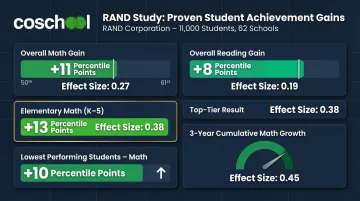
After two years, personalized learning students moved from below the national median to above it in both subjects. Benefits "may take some time to emerge" as schools gain implementation experience.
Closing Knowledge Gaps
Mastery-based and adaptive approaches prevent gaps from accumulating. A student who hasn't grasped a foundational concept receives support before moving on, rather than being left behind in a group-paced class.
This matters most in large, diverse classrooms where silent struggling often goes unnoticed. Traditional instruction forces a difficult choice: slow down for struggling students and lose advanced learners to boredom, or move forward and leave weaker students further behind. Personalized learning removes that constraint entirely.
Teacher Empowerment
Personalized learning benefits teachers too. When they have better data on each student and clear learner profiles, they spend less time on one-size-fits-all lesson delivery and more time on meaningful, targeted support.
This shifts the teacher's role from lecturer to facilitator. Instead of standing at the front delivering the same lesson to all 35 students, teachers move among small groups and individuals, providing targeted support exactly when and where students need it.
Parent and Family Engagement
Well-implemented personalized learning brings parents in as active partners—through shared learner profiles, progress updates, and involvement in goal-setting. This bridges the gap between home and school learning environments.
International research, including findings from the U.S. Department of Education, links personalized learning plans to measurable shifts in student wellbeing. Outcomes are strongest when plans include:
- Challenging academic goals that stretch each student
- Career exploration relevant to individual interests
- Leadership development opportunities
- High levels of parental involvement throughout the process
Common Challenges in Personalized Learning (and How to Address Them)
Teacher Training and Mindset Shift
Personalized learning requires educators to move away from familiar whole-class instruction toward facilitation, data interpretation, and individualized support. EdWeek Market Brief research found teacher training is the top barrier to implementation, with 44% of teachers saying personalized learning requires too much instructional time.
The path forward starts with structured training and mentoring. RAND found only 50% of teachers were satisfied with the quality and usefulness of professional development in personalized learning schools — significant room for improvement.
Professional development should focus on:
- Data literacy and translating insights into instructional action
- Facilitating student-driven learning
- Managing flexible grouping and pacing
- Using technology effectively
Technology Access and Screen Time Balance
Technology-heavy personalized learning can make students overly dependent on screens and reduce meaningful human interaction. The goal of technology should be to free up teacher time for deeper engagement — not to replace it.
RAND's implementation study found technology use in personalized learning schools skewed heavily toward routine tasks:
- 61% used tech for structured curriculum delivery
- 57% used it for reading or watching videos
- Only 37% used it for collaborative or adaptive problem-solving
- Only 20% used it for adjusting simulations
Blended approaches that preserve social learning offer the clearest fix. Technology handles routine tasks — knowledge delivery, practice, assessment — while teachers focus on discussion, critical thinking, personalized guidance, and socio-emotional support.
Scaling Personalization in Large Classrooms
Creating individual learning plans for 40+ students is not realistic without support systems. Education Week's 2019 survey of nearly 600 K-12 teachers revealed a consistent gap between aspiration and practice:
- 75% of educators "never" or "rarely" use digital software to construct learner profiles
- 60% of educators "never" or "rarely" use adaptive software to let students learn at their own pace
- 50% of teachers cited developing personalized content as a major time obstacle
- 61% of teachers had "plenty of data" but needed help translating it into instructional steps
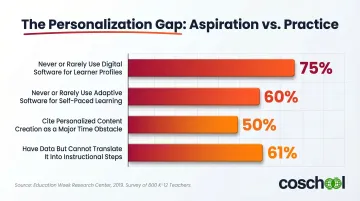
These gaps aren't a motivation problem — they're a systems problem. The right tools can help teachers manage personalization at scale without burning out:
- Mastery trackers that automate progress monitoring
- Learner profile systems that organize student data visually
- Adaptive platforms that adjust content difficulty automatically
- AI assistants that generate differentiated resources quickly
The Role of AI and Technology in Personalized Learning
How AI Makes Personalised Learning Work in the Classroom
AI-powered tools now analyse student performance data in real time, identify learning gaps, and adapt content to each learner's level — tasks that once required manual review across an entire class roster. The technology has moved from pilot programmes to mainstream classroom use faster than most predicted.
EdWeek Research Center tracking shows AI adoption among teachers nearly doubled in two years:
- 2023: 34% of teachers using AI
- 2025: 61% of teachers using AI
The CoSN 2024 Driving K-12 Innovation report shows technology leaders are converging on this priority:
- 73% identified Generative AI as one of the top three most important technology enablers
- Personalisation received an intensity score of 3.9 out of 5 (tied for highest among all accelerators)
- 42% selected "Analytics & Adaptive Technologies" as a top-three technology enabler
Specific AI-Driven Capabilities for Classroom Teachers
AI delivers several capabilities that directly support personalised learning:
Automated learner profiles: AI continuously updates student profiles based on performance data, learning preferences, and engagement patterns—eliminating manual data entry.
Conversational AI tutors: Support students between lessons with real-time guidance, hints, and feedback. Instead of waiting for the teacher's attention, students receive immediate support from an AI tutor that adapts to their level.
Instant feedback mechanisms: Help students self-correct and move forward without waiting. This reduces the teacher bottleneck where one educator must respond to 35+ students.
Data-driven insights: AI identifies patterns in student performance that would be invisible to human observation, flagging students who need intervention before they fall significantly behind.
These tools free up teachers rather than replace them. Teachers focus on high-value activities—facilitating discussions, building relationships, providing emotional support, teaching critical thinking—while AI handles routine tasks like grading, progress tracking, and adaptive content delivery.
AI in Practice: Coschool's Approach
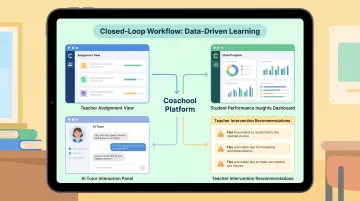
The capabilities described above come together in platforms like Coschool, which uses Generative AI to deliver a 1:1 teacher-student experience across an entire class. Coschool's tools include an AI Tutor (Vin) and AI Assistant that support real-time adaptive learning, help teachers build customisable classroom resources, and keep parents engaged in their child's learning journey.
The platform operates through a closed-loop system: teachers assign work, the AI tutor provides personalised guidance to students, the platform generates actionable insights on each student's performance, and teachers implement targeted interventions based on data. Schools using the platform have recorded an 8-12% increase in class averages — a measurable outcome that reflects what consistent, data-driven personalisation can deliver at the school level.
Frequently Asked Questions
What are the key elements of personalized learning?
Five core elements define personalized learning:
- Flexible pacing — students learn at their own speed
- Learner profiles — records of individual strengths, needs, and goals
- Student agency — meaningful choices in how students learn
- Mastery-based progression — advancement only after demonstrated understanding
- Competency-based assessment — multiple ways to show knowledge beyond traditional tests
What are examples of personalized learning?
Common examples include:
- Self-paced video lessons students can pause and rewatch
- Project-based learning where students choose topics aligned with their interests
- Mastery checks that unlock the next concept only after demonstrated understanding
- Learning playlists offering multiple resources for the same topic
- Flexible grouping where students work with peers based on current learning needs
What are common personalized learning goals?
Most schools pursue three broad aims: closing knowledge gaps before they compound, increasing student engagement and ownership, and building self-directed learning habits that extend beyond the classroom. Meeting academic standards at every learner's own pace ties all three together.
Is a PLP the same as an IEP?
No. A Personalized Learning Plan (PLP) is a voluntary, school-initiated tool focused on student strengths and goals used in general education. An Individualized Education Program (IEP) is a legally mandated document for students with identified disabilities that outlines specific special education services and accommodations. They can be used together, but serve different purposes.
What are common barriers to student learning?
The most common barriers are compounding knowledge gaps from earlier grades, one-size-fits-all instruction that ignores individual pacing, and limited feedback that leaves students uncertain of their progress. Chronic absenteeism and disengaging content compound these further. Personalized learning addresses each through adaptive support and flexible pacing.
What is student-centered learning and what are its core principles?
Student-centered learning places the learner's needs, interests, and agency at the heart of education. Its core principles — active participation in learning decisions, flexible pacing, meaningful choice, and ongoing feedback — shift the classroom from teacher-led delivery to learner-driven growth. Personalized learning puts all of these into daily practice.