Introduction
Indian schools face a structural problem that traditional approaches cannot scale past: 30:1 pupil-teacher ratios in states like Bihar and Gujarat, mixed-ability classrooms spanning multiple grade levels, and over 50% of Grade 5 students unable to read Grade 2 texts even after the pandemic.
Teachers spend more time marking papers and preparing lessons than actually teaching. Learning gaps compound silently until they become irreversible. AI in the classroom is no longer a future experiment — it is a practical, scalable response to a problem that is growing faster than schools can hire their way out of.
Too much of the conversation around AI in education focuses on the technology rather than what it actually changes day to day. The real question is simpler: does a struggling student get the right support at the right moment? Does a teacher get hours back from paperwork? Can school leaders spot learning gaps before they become permanent? Those outcomes are what matter.
This article breaks down the concrete benefits AI brings to classrooms, what schools lose by ignoring it, and how to put it to work effectively.
TLDR
- AI uses adaptive algorithms to personalize learning, reduce teacher workload, and improve student outcomes
- Benefits span 1:1 personalized learning at scale, up to 13 hours saved per teacher weekly, data-driven early intervention, and improved accessibility
- Schools implementing AI thoughtfully see measurable gains: 8-12% increases in class averages and consistent 90-92% performance levels
- AI handles repetitive tasks so teachers can focus on instruction and student relationships, not replace them
- Schools that adopt AI earlier build stronger gains in learning quality and operational efficiency over time
What Is AI in the Classroom?
AI in the classroom is already in active use across Indian schools — software that uses algorithms and data to adapt instruction, automate routine tasks, and support teachers and students in real time.
These systems analyze student performance, adjust content difficulty dynamically, and surface insights that would be impossible for a teacher to track manually across 30 or 40 students.
Where AI is applied today:
- Adaptive learning platforms that adjust content difficulty and sequencing based on each student's performance
- Intelligent tutoring systems that deliver one-on-one guided practice with real-time feedback
- Automated grading tools scoring assessments and returning formative feedback instantly
- Learning analytics dashboards giving teachers a single view of class-wide and individual progress
- AI-assisted lesson planning that recommends materials, grouping strategies, and curriculum alignment
The goal isn't AI adoption as a checkbox. It's ensuring every student learns without gaps and every teacher has the support to make that possible. At scale, AI is the only mechanism that can deliver individualized instruction in a classroom where one teacher faces 30+ students with vastly different learning levels.
Both global and national policy bodies recognize this. UNESCO characterizes AI in education as having "the potential to address some of the biggest challenges in education today, innovate teaching and learning practices, and accelerate progress towards SDG 4." India's National Education Policy 2020 reinforces this directly — mandating AI-based assessment software, adaptive formative assessment, and a National Educational Technology Forum (NETF) to guide technology integration, framing AI adoption as national policy, not experimentation.
Key Benefits of AI in the Classroom for Schools
The benefits below are tied to outcomes schools actively track: student performance, teacher efficiency, learning equity, and early intervention. All three are measurable and documented in current research.
Benefit 1: Personalized Learning at Scale
Personalized learning through AI means each student receives content, pace, and feedback tailored to their current level, moving away from the one-size-fits-all model that leaves students either behind or unchallenged.
How AI creates this in practice:
Adaptive platforms analyze student responses in real time, adjust difficulty, surface knowledge gaps, and deliver targeted content. This effectively simulates a 1:1 teacher-student experience even in large classrooms. Platforms like Coschool use Generative AI to achieve 1:1 personalized learning for every student, with Vin (the AI tutor) guiding students through homework and self-study with conversation-based support.
Why this is a benefit:
Personalization reduces frustration for struggling students and keeps advanced students engaged. These are two groups a single teacher cannot simultaneously serve at the required depth. Research from RAND Corporation found that students in personalized-learning schools gained approximately 3 percentile points in mathematics relative to comparison groups. Modest, but measurable improvement delivered at scale without adding staff.
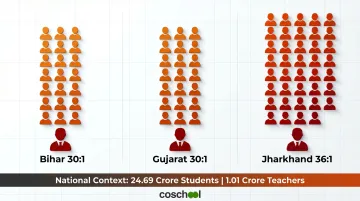
Personalization also reduces knowledge gaps over time: students don't advance until concepts are genuinely understood. This matters acutely in India, where UDISE+ 2024-25 data shows pupil-teacher ratios of 30:1 in Bihar and Gujarat, and 36:1 in Jharkhand. At these ratios, delivering individualized instruction through human effort alone is arithmetically impossible.
KPIs impacted:
- Student engagement rates
- Assignment completion rates
- Assessment scores
- Knowledge retention
- Reduction in learning gaps across cohorts
When this benefit matters most:
Large classrooms with high student-to-teacher ratios, mixed-ability groups, and students recovering from learning disruptions. All are common in Indian school contexts, where 24.69 crore students are served by 1.01 crore teachers.
Benefit 2: Teacher Empowerment and Time Savings
AI frees teachers from time-consuming, repetitive tasks: grading, generating practice questions, drafting lesson plans, and identifying common errors. The time recovered goes back to instruction, mentoring, and student relationships.
How this works in practice:
AI tools draft lesson outlines, generate leveled questions, flag common mistakes across a class, and automate initial grading of objective assessments, returning measurable hours to teachers each week. Coschool's AI Assistant, for example, generates lesson plans, question banks, engagement tips, and customizable classroom resources that enable teachers to provide personalized support without extensive manual preparation.
The time math:
McKinsey research estimates that 20-40% of current teacher hours, roughly 13 hours per week, are spent on tasks that existing AI technology can automate. Specifically:
- Lesson preparation can be reduced from 11 hours to 6 hours (5-hour saving)
- Evaluation and feedback from 6 hours to 3 hours (3-hour saving)
- Administration from 5 hours to 3 hours (2-hour saving)
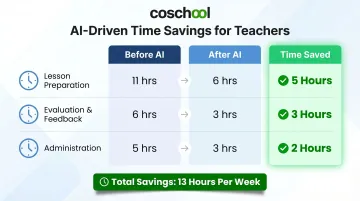
Thirteen hours per week redirected from paperwork to direct student engagement addresses both teacher satisfaction and learning quality at the same time.
Teacher retention improves when teachers feel supported rather than buried in admin. OECD TALIS 2024 data shows that 52% of teachers cite administrative work as a source of stress and 40% cite excessive marking. AI-assisted grading and admin automation directly address both stressors.
KPIs impacted:
- Teacher hours spent on non-instructional tasks
- Lesson preparation time
- Quality and frequency of student feedback
- Teacher satisfaction scores
When this benefit matters most:
Schools where teachers manage multiple subjects, large classes, or limited planning periods, where bandwidth is chronically stretched and burnout rates are high.
Benefit 3: Data-Driven Early Intervention
AI continuously analyzes student performance data: attendance patterns, assessment scores, incomplete work, and recurring errors. It surfaces early warning signals before small gaps become large ones.
How this translates to action:
AI dashboards give teachers and school leaders a real-time picture of each student's learning trajectory, enabling targeted support decisions rather than reactive ones. Coschool's SchoolAI platform operates through a closed-loop system where Vin (the AI tutor) guides students, analyzes their interactions, and shares actionable insights with teachers about each student's progress, strengths, and areas needing improvement.
What the research shows:
Early identification is far more effective than remediation after a student has fallen significantly behind. The World Bank warns that children who cannot read by age 10 "usually fail to master reading later in their schooling career", meaning gaps left unaddressed in early grades become effectively permanent.
In India, the scale of undetected learning gaps is significant. Research from the Observer Research Foundation shows that even in "above average" states and districts, 30-35% of children struggle with Foundational Literacy and Numeracy. When detection happens early, IES research confirms that systematic screening and progress monitoring drive measurable improvement in intervention timing.

KPIs impacted:
- Rate of on-time intervention
- Reduction in students requiring intensive remediation
- Teacher response time to learning gaps
- Student progression rates
When this benefit matters most:
Schools with high student volumes where individual monitoring is difficult, and especially at key academic transition points like foundational literacy and numeracy stages (Grades 1-3).
What Happens When Schools Ignore AI in the Classroom
Without AI tools, teachers are forced to teach to the middle—some students are left bored while others fall behind, and neither group gets the support they need at scale. This is not a theoretical problem. It is the lived reality in classrooms with 30+ students where one teacher cannot physically provide individualized support.
The consequence is cumulative: learning gaps that go undetected in early grades grow harder and more expensive to address over time. The World Bank projects that at the current rate of improvement, 43% of children globally will still be learning-poor in 2030. In India, even with national recovery efforts post-pandemic, Grade 3 scores remain below pre-pandemic 2017 benchmarks.
The competitive risk is just as real. The AI in education market is growing at approximately 42.83% CAGR through 2030, and families are increasingly aware of what AI-enabled schools can offer.
Schools that delay face pressure on three fronts:
- Student outcomes — widening learning gaps that go unaddressed
- Teacher retention — educators drawn to schools with better tools and support
- Parent expectations — growing demand for data-driven, personalized learning
Within India, the performance gap between top and bottom states is widening precisely because access to effective interventions is unequal. Schools that hold off on AI-powered diagnostic and adaptive tools will find that gap increasingly difficult to close.
How Schools Can Get the Most Value from AI in the Classroom
AI tools deliver the most impact when implemented with clear goals—not as a blanket technology deployment, but tied to specific outcomes: closing learning gaps, reducing teacher workload, or improving early intervention.
Focus on the Highest-Value Use Cases
McKinsey research identifies three activity categories where AI tools are most deployable in K-12 settings:
- Preparation — lesson planning, resource creation, differentiated materials
- Evaluation and feedback — formative assessments, progress tracking, gap identification
- Administration — attendance, reporting, communication workflows
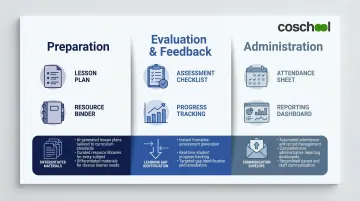
Schools should map their AI tool selection to these three categories for the clearest results.
Ensure Consistent Use
Effectiveness depends on consistent use. AI requires ongoing data input and regular review of insights by teachers and administrators. Sporadic or passive use limits returns significantly.
Platforms like Coschool are built to fit inside existing school workflows—combining teacher tools and student learning in one system so consistent use becomes a habit, not an extra task.
Invest in Change Management
Schools should invest in basic change management: helping teachers understand what AI does and doesn't do, setting clear expectations with parents, and building review cycles that ensure AI insights lead to action—not just documentation.
These implementation steps are reinforced at the policy level. India's NEP 2020 provides a national framework for technology adoption, including the creation of a National Educational Technology Forum (NETF), development of AI-based assessment software, and strengthening of DIKSHA for teacher professional development. Schools adopting AI tools within this framework are aligning with national policy.
Research from Digital Promise and the Center for Outcomes Based Contracting demonstrates that outcomes-based contracting for EdTech boosts implementation rates and provides teachers and students with greater understanding of the tool's purpose and best use. Schools should demand vendor contracts tied to measurable student outcomes, invest in teacher training through DIKSHA and similar platforms, and maintain human oversight of AI-generated outputs.
Frequently Asked Questions
How can AI be beneficial to students in the classroom?
AI benefits students by personalising their learning experience, delivering immediate feedback on their work, and ensuring they don't progress past concepts they haven't fully understood. This improves engagement, reduces frustration, and leads to better learning outcomes and knowledge retention.
Does AI in education replace teachers?
No. AI supports and amplifies what teachers do—it handles repetitive tasks like grading and surfaces data insights that would be impossible to track manually. Human judgment, relationships, and instructional quality remain irreplaceable and central to effective learning.
How does AI help teachers save time in schools?
AI automates lesson drafting, question generation, grading of objective assessments, and class-wide error analysis. This returns approximately 13 hours each week that teachers can redirect toward direct student support, mentoring, and personalised instruction.
How does AI support students with different learning needs?
AI adapts content difficulty in real time based on each student's responses and offers alternative formats—text-to-speech, visual explanations, and multilingual support. This ensures students with special needs or learning differences can access grade-level material with appropriate scaffolding.
Is AI in education safe for students?
Responsible AI platforms follow strict data privacy protocols, collect only educationally relevant data, and give schools and parents visibility into what is collected and how it is used. Schools should evaluate any platform against India's Digital Personal Data Protection Act, 2023, which requires verifiable parental consent and prohibits behavioural tracking and targeted advertising directed at children.
What should schools consider before implementing AI tools?
Schools should evaluate three key areas: whether the tool addresses a specific instructional or operational need, whether teachers will receive adequate training and support, and whether the platform protects student data and is accessible to all students regardless of ability or background.