
Introduction
Most Indian schools now own computers. Far fewer actually use them to teach. The National Education Policy (NEP) 2020 explicitly mandates technology integration, establishing the National Educational Technology Forum (NETF) to drive implementation — yet owning hardware and running a functioning digital classroom are two very different things. Parents increasingly compare facilities when choosing schools, and students without digital support risk falling behind peers who benefit from adaptive learning tools.
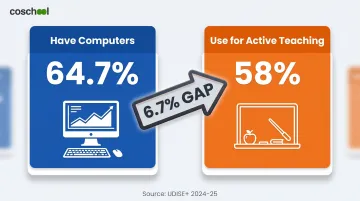
According to UDISE+ 2024-25 data, 64.7% of India's 14.71 lakh schools have computers, but only 58% use them actively for teaching — a gap that reflects procurement over purpose. ASER 2024 adds a harder truth: just 23.4% of Std III students in government schools can read at Std II level, meaning most children enter upper grades already behind.
The conversation around digital classrooms too often stops at equipment — projectors, smart boards, procurement budgets. This article goes further, examining the operational advantages that school leaders can actually measure: better learning outcomes, stronger teacher performance, and classroom integration that works.
TL;DR
- Digital classrooms create data-driven learning environments that improve outcomes for students, teachers, and schools
- Key advantages include personalized learning at scale, teacher empowerment through automation, and measurable gains in engagement and retention
- Delaying digital adoption widens learning gaps, accelerates teacher burnout, and drives enrollment toward schools that already have these tools
- NEP 2020 Chapters 23-24 mandate technology integration, making digital classrooms policy-aligned investments
- AI-powered platforms like Coschool deliver 1:1 learning experiences for every student — even in large Indian classrooms
What Is a Digital Classroom?
A digital classroom is a learning environment where technology tools—interactive boards, digital content, learning management systems, and adaptive platforms—work together to deliver, manage, and assess instruction.
A projector on the wall or a single smart board doesn't qualify. A fully realized digital classroom integrates several components working in concert:
- Content delivery systems that present curriculum in interactive formats
- Student response tracking that captures participation and comprehension in real time
- Teacher productivity tools that reduce planning and administrative load
- Home-school connectivity that keeps parents and students aligned outside the classroom
This distinction between hardware and actual learning outcomes matters. UDISE+ data shows a 6.7 percentage point gap between schools that have computers (64.7%) and those using them for active teaching (58%). Hardware without supporting software and teacher training rarely translates into classroom-level impact.
Digital classrooms are means to specific outcomes: closing knowledge gaps, increasing teacher efficiency, and preparing students for an economy that runs on digital skills. They are not standalone infrastructure upgrades.
Key Advantages of Digital Classrooms for Schools in India
The following advantages are selected for their direct operational relevance to Indian school leaders. Each connects to outcomes affecting learning quality, teacher effectiveness, and institutional performance.
Personalized Learning at Scale
In a class of 40-60 students, no two learners arrive with identical gaps. Personalized learning addresses this by adapting instruction to each student's pace, prior knowledge, and specific weaknesses—rather than delivering the same content uniformly to everyone.
Digital classrooms enable this through adaptive content platforms. These systems identify where each student struggles, serve targeted practice, and flag at-risk learners to teachers—without requiring manual assessment of every student individually.
Why this matters:
In large Indian classrooms, the traditional model means slower learners fall silently behind while stronger students remain under-challenged. Digital tools resolve both problems simultaneously by adjusting difficulty in real time.
ASER 2024 data reveals that over 75% of Std III students and over 55% of Std V students in government schools cannot read at expected grade levels. These gaps are cumulative—by Std VIII, approximately one-third of students still lack foundational reading ability.
The World Bank's 2022 Learning Poverty Brief places India's learning poverty rate at 56.1%—meaning more than half of children cannot read and understand a simple text by age 10.
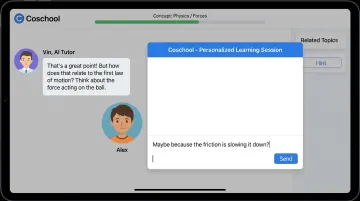
Personalized pathways reduce knowledge gap accumulation across grades, directly impacting board exam performance and retention rates. Platforms like Coschool use Generative AI to simulate a 1:1 teacher-student experience through Vin, an AI tutor that provides guided, Socratic questioning rather than simply delivering answers—making individualized learning achievable even in schools with limited faculty resources.
KPIs impacted:
- Student learning gap closure rate
- Average assessment scores across cohorts
- Number of students requiring remediation at year-end
- Student retention year-over-year
When this advantage matters most:
This benefit is critical in schools with large class sizes (40+ students), mixed-ability classrooms, and those tracking learning outcomes under NEP 2020's competency-based assessment framework.
Teacher Empowerment and Operational Efficiency
Ask most teachers what gets in the way of good instruction, and the answer is rarely the students. It's the prep time, the paperwork, and the administrative load that crowds out actual teaching.
Digital classrooms deliver this through pre-built lesson plans, automated attendance and progress reports, real-time classroom dashboards, and AI-powered assistants that reduce preparation time and surface actionable student data without extra teacher effort.
Teacher burnout and high attrition are real operational risks for Indian schools. When teachers are overwhelmed with administrative tasks, teaching quality suffers. Digital tools free up the mental energy teachers need for impactful instruction.
ASER 2024 found that 66.6% of Std I-II classrooms operate in multigrade settings, and over 80% of government primary schools report receiving Foundational Literacy and Numeracy directives—adding administrative compliance burden on top of daily pedagogical responsibilities.
In these conditions, differentiated instruction becomes physically impossible without technology support.
Coschool's AI Assistant generates lesson plans, question banks, engagement tips, and learning resources—reducing the hours teachers spend on preparation and grading. This enables teachers to focus on high-value classroom interactions rather than paperwork.
Schools that reduce teacher administrative load consistently report lower attrition, stronger parent communication, and better instructional consistency across sections—each of which has a direct line to enrollment stability.
KPIs impacted:
- Teacher preparation time per lesson
- Teacher attrition rate
- Parent satisfaction scores
- Number of personalized interventions per term
When this advantage matters most:
This benefit compounds in schools with high student-to-teacher ratios, frequent curriculum updates, and multi-section classes where consistency of instruction is difficult to maintain.
Measurable Gains in Student Engagement and Learning Outcomes
Engagement in a digital classroom goes beyond attention—it includes active participation, self-paced practice, and regular formative feedback loops that make learning visible to both students and teachers.
Digital classrooms create this through interactive multimedia content and real-time response tools. Teachers can see comprehension across the entire class, not just from the few students who raise their hands.
Why this matters:
Disengaged students in traditional classrooms often go unnoticed until exams reveal the damage. Digital tools surface learning gaps during instruction, when correction is still timely and impactful.
Research by Black and Wiliam (1998) found that formative assessment interventions produce effect sizes between 0.4 and 0.7—larger than most educational interventions. They noted that "improved formative assessment helps low achievers more than other students and so reduces the range of achievement while raising achievement overall."
Digital platforms enabling frequent low-stakes assessment put this evidence into practice at scale—something paper-based tests in 40-60 student classrooms simply cannot achieve.
UDISE+ 2024-25 shows secondary dropout rates at 11.5% nationally, with states like West Bengal at 20.0% and Karnataka at 18.3%. Schools with higher engagement rates consistently report lower dropout numbers, better board results, and stronger parent trust.
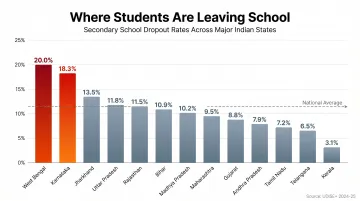
Early digital detection of disengagement gives schools a window to intervene before a student disengages entirely—when it still matters.
Schools using Coschool's SchoolAI have demonstrated 8-12% increases in class averages, showing that personalized, conversation-led learning delivers measurable improvement.
KPIs impacted:
- Classroom participation rates
- Formative assessment scores
- End-of-term test performance
- Dropout/retention rates
- Parent-reported satisfaction with learning progress
When this advantage matters most:
This benefit is especially significant in middle and secondary grades where disengagement peaks, and in schools preparing students for competitive exams where consistent conceptual clarity is non-negotiable.
What Happens When Digital Classrooms Are Missing or Ignored
The cost of inaction compounds over time. Schools without digital tools continue relying on one-directional instruction, where teachers cannot see which students genuinely understand content. Learning gaps accumulate quietly and only become visible at exam time, when remediation is too late and too expensive.
ASER 2022 reported that 30.5% of all children take paid private tuition classes, up from 26.4% in 2018—a 4.1 percentage point increase. This rising expenditure on supplementary instruction shows schools are failing to close learning gaps internally, pushing remediation costs directly onto families.
Institutional Risk
As neighboring schools modernize, delayed adoption creates enrollment pressure, parent dissatisfaction, and widening reputational gaps — especially in urban and semi-urban markets where parents actively compare facilities. ASER 2024 shows government school enrollment at 66.8% (down from 72.9% in 2022), indicating parents are moving toward institutions they perceive as higher quality.
Teacher-Side Consequences
Without digital support tools, the pressure on teachers becomes unsustainable. Common outcomes include:
- Inconsistent lesson quality across sections due to limited planning resources
- Reduced ability to personalize instruction for struggling students
- Higher burnout and attrition, making it harder to retain qualified educators
How to Get the Most Value from a Digital Classroom
Return on digital classroom investment depends heavily on implementation quality, not just technology purchased. Schools treating it as a one-time infrastructure upgrade see limited results, while those integrating it into daily teaching routines see compounding gains.
Value is maximized when three conditions are met:
- Teacher training goes beyond setup — ongoing professional development should focus on interpreting student data and acting on insights, not just operating equipment
- Data must drive decisions — performance insights need clear review workflows so they translate into interventions, not just reports that get filed away
- Parents stay in the loop — platforms that share student progress with parents extend learning continuity beyond school hours and reinforce what's taught in class
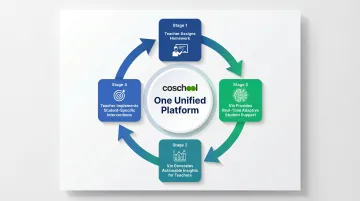
Platforms that combine teacher tools, adaptive student learning, and parent communication in a single system consistently outperform fragmented setups where different tools don't talk to each other. Coschool's SchoolAI operates as a closed-loop system: teachers assign homework, Vin guides students with real-time adaptive support, Vin shares actionable insights with teachers, and teachers implement student-specific interventions — all within one platform rather than across disconnected tools.
Conclusion
The true value of digital classrooms for Indian schools lies in three compounding outcomes: students who learn without gaps, teachers who teach with clarity and less friction, and schools that can measure and demonstrate results.
These advantages grow over time when digital tools become part of daily instruction—not treated as supplementary aids. The cost of waiting grows with every academic year that passes without data-driven instruction.
NEP 2020 has made technology integration a national policy priority through Chapters 23 and 24. The infrastructure backing this shift is substantial:
- Samagra Shiksha has sanctioned 120,614 ICT labs and **82,120 smart classrooms** nationally
- DIKSHA has logged over 5,749 crore learning minutes since April 2020
- Funding pathways are already established for schools ready to act
Digital classrooms represent an ongoing institutional practice aligned with India's educational direction under NEP 2020—not a one-time technology purchase. Schools that act on this distinction now—embedding AI-powered tools into daily instruction rather than piloting them on the margins—will see the difference in student outcomes within a single academic year.
Frequently Asked Questions
What is a digital classroom and how is it different from a traditional classroom?
A digital classroom is an integrated learning environment using adaptive content, interactive tools, and real-time feedback systems to personalize instruction and track student progress continuously. Unlike traditional classrooms where instruction is uniform and assessment is delayed, digital classrooms adjust to individual student needs during lessons and provide immediate data to teachers.
How do digital classrooms support India's NEP 2020 goals?
NEP 2020 Chapters 23 and 24 mandate technology integration across teaching, assessment, and administration. Digital classrooms help schools implement competency-based frameworks, provide equitable access to quality content, and track learning outcomes systematically — all requirements that are difficult to meet through traditional methods alone.
Are digital classrooms feasible for schools in smaller cities or with limited budgets?
Cloud-based and AI-driven platforms have significantly lowered infrastructure barriers. Many platforms operate on existing internet connections without requiring extensive hardware investments. The ROI is measurable through reduced remediation costs, improved retention, and better outcomes—making digital classrooms increasingly accessible even for budget-conscious institutions.
How do digital classrooms help teachers manage large class sizes effectively?
Automated progress tracking, AI-generated insights, and pre-built lesson resources reduce manual workload even in classes of 40–60 students. Teachers get specific data on who needs support and where, making differentiated instruction achievable without individually assessing each student.
What role does AI play in modern digital classrooms?
AI identifies learning gaps in real time and adjusts content difficulty to match each student's demonstrated understanding. Coschool's AI tutor Vin uses Socratic dialogue to build genuine comprehension, enabling near-1:1 learning experiences at scale.
How can schools measure whether their digital classroom investment is working?
Schools should track assessment score trends across cohorts, student engagement rates (participation, question frequency), teacher preparation time reductions, and year-on-year learning gap closure. Platform dashboards showing these metrics enable data-driven ROI evaluation. Schools using comprehensive platforms like Coschool report 8-12% increases in class averages as concrete proof of impact.