Introduction
Every morning, over 248 million students across India walk into classrooms that were never designed to teach them as individuals. In a typical classroom of 40 students—the reality across most private schools in states like Telangana and Andhra Pradesh—each child arrives with different strengths, different gaps in understanding, and different speeds at which they grasp new concepts. One student breezes through fractions while another struggles with basic division. A third learns best through conversation, while their classmate needs visual diagrams to understand the same concept.
Traditional teaching methods struggle with this reality. Even the most dedicated teacher cannot provide personalized attention to 40 unique learners simultaneously while managing lesson planning, grading, and administrative tasks that consume 13 hours per week on average.
The numbers reflect this gap. According to ASER 2024 data, only 48.1% of Grade 5 students in rural India can read a Grade 2 level text, and over 70% cannot perform basic division. One-size-fits-all instruction isn't closing this gap — it's sustaining it.
This is where artificial intelligence enters education — not as a replacement for teachers, but as the tool that makes personalized learning scalable. AI-powered platforms analyze each student's performance in real time, adapt content to their current level, and surface clear data on each student's progress while flagging knowledge gaps before they compound.
This guide explores exactly how AI transforms the classroom experience for students, teachers, and parents across the K-12 education ecosystem.
TLDR
- AI personalizes learning by analyzing student performance data and adapting content difficulty and pacing to each learner's unique needs
- Students gain deeper engagement through appropriately challenging material, while teachers reclaim up to 13 hours weekly from automated administrative tasks
- Coschool's AI tutor Vin teaches through conversation — not passive content consumption — so students build critical thinking as they learn
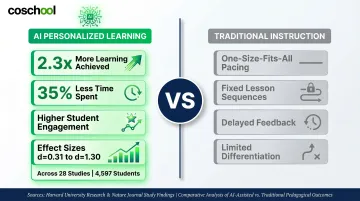
- Real-world evidence shows AI tutoring can deliver 2.3 times more learning in 35% less time compared to traditional active learning methods
What is AI in Personalized Learning?
Personalized learning is an educational approach where content, pace, and assessments are tailored to each student's individual needs, strengths, and learning gaps—the opposite of standardized instruction that delivers identical material to every student regardless of ability level. According to RAND Corporation's research, true personalized learning includes four core components: up-to-date learner profiles, customized learning paths, competency-based progression, and flexible learning environments.
Traditional personalized learning faces a fundamental constraint: the teacher-to-student ratio. In India's primary schools, the average ratio sits at 21:1. Providing genuinely individualized attention at that scale is impossible when teachers also manage lesson planning, grading, and administrative tasks.
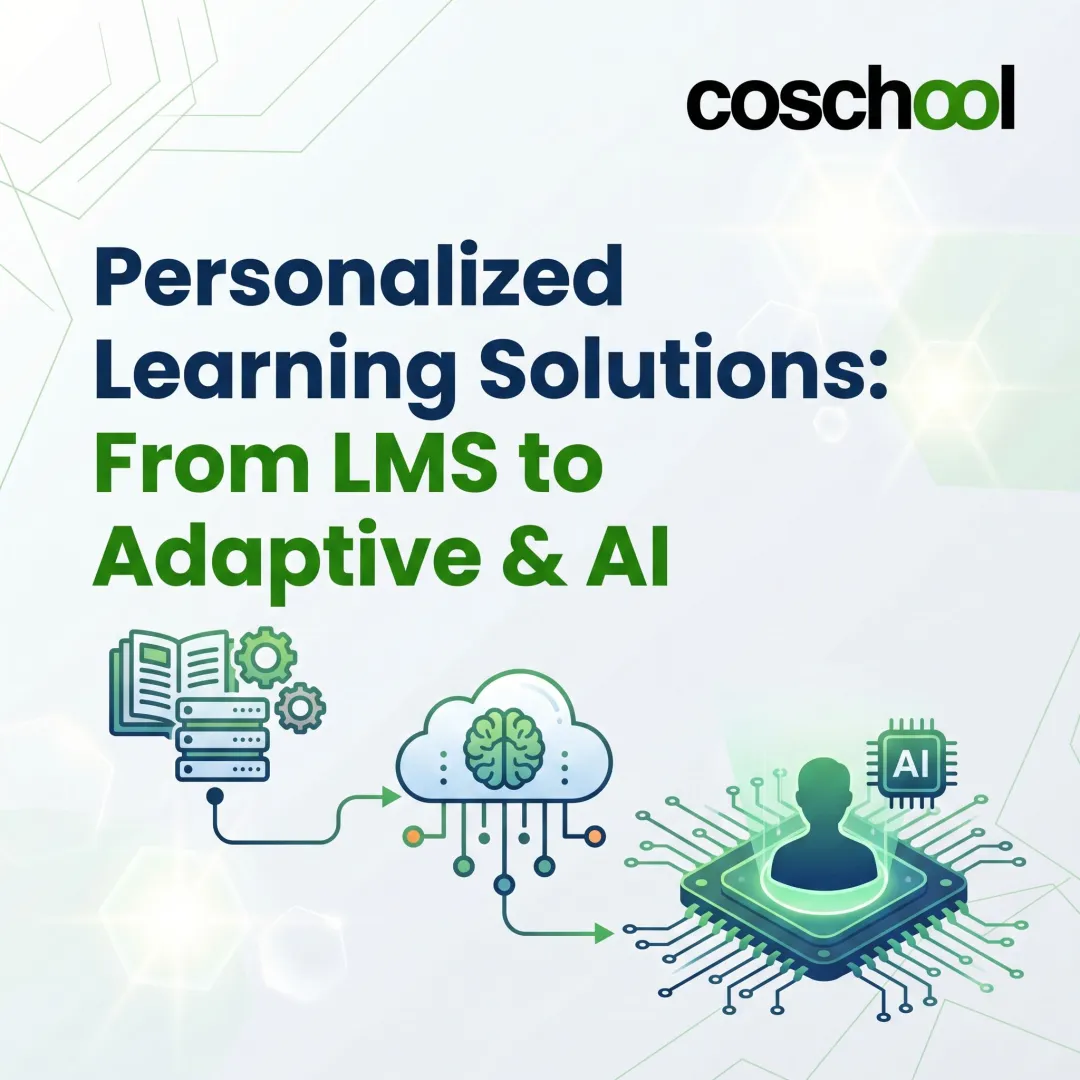
AI makes personalization scalable by continuously analyzing learner data—performance patterns, pace, comprehension levels, areas of struggle—and automatically adjusting what each student sees next. The teacher sets goals and oversees the learning journey; AI handles the real-time, student-by-student adaptation that no teacher can manage alone across a full classroom.
Personalized vs. Adaptive Learning
These terms are often used interchangeably, but they represent different scopes:
- Adaptive learning modifies content difficulty and sequence based on real-time performance data, advancing students when they master a concept and providing remedial support when they struggle
- Personalized learning takes a broader view, factoring in student interests, long-term goals, preferred learning formats, and social-emotional context alongside performance data
In practice, most effective AI-powered platforms combine both—using adaptive engines to drive content sequencing while personalizing the broader learning experience around each student's context and goals.
How AI Powers Personalized Learning in the Classroom
Real-Time Data Collection and Learner Profiles
AI-powered learning begins with continuous data collection. As students interact with digital content, the system tracks what they answer correctly, where they slow down, which concepts they skip, how long they spend on each problem, and which explanation formats (video, text, interactive) lead to mastery.
This data feeds machine learning algorithms that build a dynamic learner profile for each student — a continuously updated record of their knowledge, skills, and learning patterns.
Unlike static assessments that provide snapshots at fixed intervals, AI learning systems update these profiles in real time, creating a living record of each student's educational journey.
Adaptive Content Delivery
Based on the learner profile, AI systems serve content matched to the student's current level:
- A student who has mastered fractions moves ahead to decimals
- A student struggling with basic multiplication receives targeted practice and alternative explanations before advancing
- The system chooses the delivery format—video explanation, worked example, interactive simulation—based on which approach has previously worked best for that individual learner
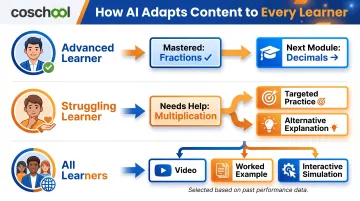
This automatic differentiation happens continuously for every student in the classroom, creating individualised learning paths without requiring teachers to manually create 40 different lesson plans.
Conversational AI Tutoring
Modern generative AI has introduced a powerful new learning method: learning through conversation. Rather than selecting answers from multiple-choice options or watching pre-recorded videos, students can now ask questions in their own words and receive context-specific, personalised responses from AI tutors.
Platforms like Coschool use this conversational approach through their AI Tutor, Vin, which employs a guided Socratic method — asking probing questions, offering hints, and walking students through problem-solving rather than simply providing answers. The result is a 1:1 tutoring dynamic that builds genuine understanding, not just correct responses.
Real-Time Feedback Loops
AI provides immediate, specific feedback after each student attempt—not just marking answers as correct or incorrect, but explaining why an answer is wrong, offering hints, and suggesting next steps. Research from Harvard demonstrates the effectiveness of this approach: in a randomised controlled trial with 194 students, those using an AI tutor learned 2.3 times more than those in traditional active learning while spending 35% less time on the material. Students also reported significantly higher engagement and motivation with AI-driven feedback.
This immediate correction prevents misconceptions from becoming ingrained and keeps students moving forward without waiting hours or days for teacher-graded assignments to return.
Intelligent Gap Detection
Most critically, AI continuously scans for knowledge gaps before they compound. The system flags when a student is missing a foundational concept required for upcoming material—for example, catching that a student hasn't mastered place value before attempting multi-digit multiplication. This enables early intervention rather than remediation after failure, preventing the accumulation of learning gaps that plague traditional instruction.
Key Benefits of AI Personalized Learning for Students, Teachers, and Parents
For Students: Deeper Engagement and Genuine Mastery
When content matches a student's current ability level and feels relevant to their progress, curiosity replaces frustration. AI-powered personalization eliminates two common engagement killers:
- Boredom for advanced learners forced to sit through material they've already mastered
- Overwhelm for students who need more time, receiving content before they're ready
By serving appropriately challenging material, AI keeps students in the "zone of proximal development" where learning happens most effectively. A systematic review of 28 studies covering 4,597 K-12 students found that AI-driven intelligent tutoring systems generally produced positive learning outcomes compared to traditional instruction, with effect sizes ranging from d = 0.31 to d = 1.30 across different implementations.
For Teachers: Reclaiming Time for What Matters
McKinsey research across four countries found that K-12 teachers work an average of 50 hours per week, with approximately 20-40% of that time—roughly 13 hours weekly—spent on preparation, grading, and administration that existing AI technology could automate or simplify.
AI handles routine tasks:
- Automated progress tracking across all students
- Content matching based on individual performance data
- Basic assessment analysis and gap identification
- Lesson resource generation and question bank creation
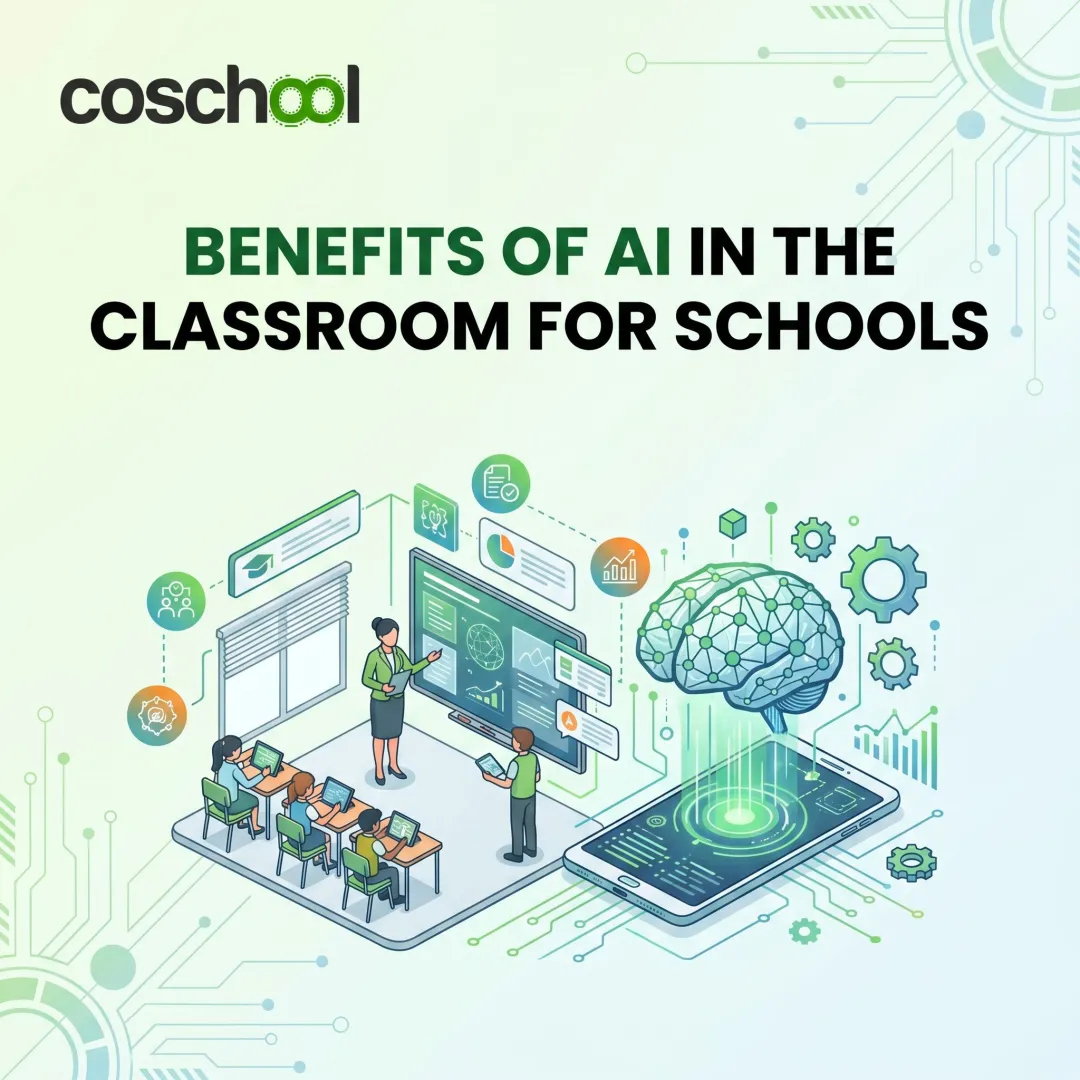
This frees teachers to focus on high-value activities that only humans can provide: facilitating meaningful discussions, providing emotional support, designing creative projects, building relationships with students, and making nuanced pedagogical judgments.
For Parents: Visibility Into Learning Progress
Real-time dashboards and progress reports show parents exactly where their child is thriving and where support is needed — moving well beyond the traditional model of waiting for quarterly report cards or parent-teacher meetings.
This visibility enables genuine home-school partnerships. Parents can reinforce learning at home, celebrate progress in specific areas, and collaborate with teachers on targeted interventions when gaps appear.
For Schools: Equitable Learning at Scale
In India, where UDISE+ 2023-24 data shows pupil-teacher ratios of 21:1 at primary level and 24:1 at higher secondary — with many classrooms exceeding 40 students — individualized attention through traditional methods is structurally impossible. AI makes quality, personalized instruction accessible even in overcrowded or under-resourced schools.
This is particularly significant given that ASER 2024 data shows a persistent 19 percentage point gap between government and private school reading outcomes in Grade 5 — a gap that one-size-fits-all instruction in large classes cannot close.
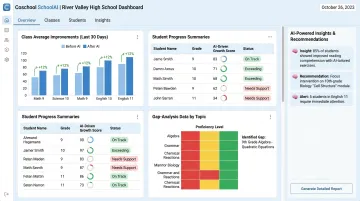
Schools using AI-powered platforms like Coschool's SchoolAI have documented 8-12% increases in class averages — a concrete signal that personalization at scale moves the needle on outcomes.
The Role of Teachers in an AI-Enhanced Classroom
AI Does Not Replace Teachers
The most critical misconception to address directly: AI is not here to replace teachers. What AI takes off teachers' plates is the repetitive, data-heavy layer of instruction — content delivery calibration, basic assessment, progress tracking, resource generation. What teachers do best becomes more central, not less.
Teaching requires things no algorithm can replicate:
- Mentoring students through setbacks and self-doubt
- Recognizing when a child is struggling beyond academics
- Motivating with the kind of inspiration only a passionate human educator can offer
- Exercising nuanced judgment in complex, in-the-moment situations
Teacher as Learning Architect and Human Anchor
In an AI-enhanced classroom, the teacher's role evolves rather than diminishes. AI manages content sequencing and pacing; teachers focus on meaning, real-world connection, and supporting each child's growth as a person.
KnowledgeWorks' framework on educator competencies for personalized environments emphasizes teachers as the primary drivers of equity-centered learning. No single teacher needs to exhibit every competency at once — personalized learning depends on a broader learning community, not isolated individual effort.
Teacher Empowerment Through AI Tools
Rather than drowning in manual data work, teachers receive AI-generated insights they can act on:
- Class-wide performance dashboards showing at a glance which students need intervention and in which specific areas
- Automated generation of differentiated lesson materials matched to different ability levels
- Instant identification of knowledge gaps before they compound
- Time reclaimed from grading redirected toward one-on-one student conversations
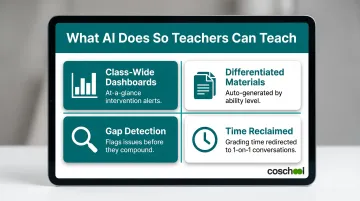
Platforms like Coschool are built around this empowerment principle, providing an AI Assistant that puts practical insights directly into teachers' hands while handling administrative overhead. In practice, this means a teacher can spend the first ten minutes of class reviewing a gap-analysis summary from the night before — then spend the lesson actually addressing it.
Human Elements AI Cannot Replicate
Social-emotional learning, building trust with students, recognizing non-academic struggles, facilitating peer collaboration, modeling curiosity and resilience, celebrating effort alongside achievement — these remain the teacher's primary domain in an AI-enhanced classroom. AI can surface that a student is falling behind in fractions. Only a teacher can notice that the same student hasn't smiled in a week.
Challenges and Ethical Considerations in AI-Driven Learning
Data Privacy and Responsible Use
AI personalized learning depends on continuous collection of student data—performance records, interaction patterns, time-on-task metrics. Schools must choose platforms that comply with data protection standards and maintain transparency with parents about what is collected and how it is used.
In India, the Digital Personal Data Protection Act, 2023 sets strict requirements for EdTech platforms operating in K-12 settings:
- Verifiable parental consent is mandatory for processing any data of children under 18
- Tracking and behavioral monitoring directed at children is prohibited
- Penalties for violations can reach up to ₹200 crore
Platforms must implement these consent mechanisms and disable tracking features for users under 18 before deployment in any Indian school.
The Risk of AI Bias and Over-Reliance
AI systems are trained on data, which can carry inherent biases impacting content recommendations or assessments for certain learner groups. Research published in Heliyon found that AI systems in education can perpetuate societal biases present in training data, resulting in biased outcomes for underrepresented student demographics.
Bias in recommendations is only part of the problem. A University of Technology Sydney report warns that unstructured AI use risks "cognitive atrophy"—students outsourcing thinking to AI rather than building their own reasoning skills.
Human oversight addresses both risks directly: teachers must review AI outputs, guide appropriate AI use, and ensure students develop metacognitive skills alongside content knowledge.
The Digital Divide
Personalized AI learning requires device access and internet connectivity. UDISE+ 2024-25 data shows that while 63.5% of Indian schools now have internet and 64.7% have computers, approximately 500,000 schools still lack either computers or internet, with rural schools lagging urban schools by 20-30% in connectivity.
This gap creates a troubling pattern: the most promising AI interventions tend to reach students in well-resourced urban schools, while under-resourced schools serving students with the greatest learning needs lack the basic technology to deploy these tools.
EdTech developers and schools must prioritize offline-capable and low-bandwidth solutions to avoid deepening educational inequality rather than reducing it.
Frequently Asked Questions
What is AI personalized learning?
AI personalized learning is an educational approach where artificial intelligence analyzes each student's performance, pace, and learning patterns to tailor content, assessments, and feedback to their individual needs—making 1:1 learning scalable across an entire classroom without extra burden on the teacher.
How is AI used for personalized learning?
AI collects real-time learner data, builds individual performance profiles, adapts content difficulty and format, delivers instant feedback, and flags knowledge gaps before they compound. Every step runs continuously for each student without requiring manual input from teachers.
What is an example of personalized learning with AI?
An AI tutor identifies a Grade 6 student struggling with fractions and serves targeted practice problems at the appropriate difficulty level, a short explanatory video using visual models, and a follow-up quiz. Based on the student's performance, the system adjusts difficulty until mastery is confirmed, then advances to decimals—while the teacher gets a clear progress summary to guide their next steps in class.
What is advanced personalized learning?
Advanced personalized learning goes beyond content pacing to incorporate learner goals, interests, social-emotional context, and long-term skill development. Powered by generative AI and predictive analytics, these systems anticipate gaps before they form and engage students through conversation rather than static content—adapting not just what is taught, but why it matters to each learner.
Will L&D be replaced by AI?
No. AI takes over routine tasks—content sequencing, basic assessment, progress tracking—so educators can focus on mentoring, creativity, and relationship-building. These are the human dimensions of learning that machines cannot replicate. Teachers become more central to the process, not less, as the people who give AI-enabled learning its meaning and direction.