Introduction
Choosing a Learning Management System is one of the highest-stakes decisions a school administrator makes. A poor choice wastes budget and disrupts learning continuity for an entire academic year — sometimes longer.
The decision touches everyone: how teachers deliver lessons, how students receive support, and how parents stay informed about learning progress.
The market reflects just how seriously schools are taking this. The global K-12 LMS market is projected to grow from USD 6.5 billion in 2024 to USD 27.2 billion by 2030, driven in large part by schools across India and Asia-Pacific accelerating digital adoption post-pandemic. Hybrid and blended learning are no longer temporary fixes — they're the new baseline.
This guide walks through exactly what to evaluate, what questions to ask vendors, and what separates a platform that genuinely supports learning from one that just looks good in a demo.
TL;DR
- A good LMS brings course delivery, progress tracking, assessments, and parent communication into one place — reducing administrative overhead for teachers
- For K-12 schools, prioritize ease of use, adaptive learning support, parent engagement tools, and total cost of ownership
- Cloud-based SaaS solutions are best suited for most schools due to low maintenance and accessibility
- Evaluate platforms across pedagogy fit, data security, and scalability — not just upfront price
- Platforms like Coschool combine AI tutoring, teacher tools, and parent dashboards to close learning gaps before they widen
What Is a Learning Management System?
A Learning Management System (LMS) is centralised software that brings lesson planning, student assessment, progress tracking, and parent communication into one platform. Instead of managing separate tools for each function, schools get a single, connected system.
Common terminology confusion exists around LMS, VLE (Virtual Learning Environment), and CMS (Course Management System). These terms are often used interchangeably, though VLE is more common in UK and European contexts, while CMS traditionally referred to course content organisation. The key distinction: an LMS includes learner tracking and assessment reporting specifically built for education, unlike a general content management system that only monitors pageviews.
Core Features of a School LMS
The core components of a school LMS includes:
- Course creation and content delivery — teachers organise lessons, upload materials, and structure learning modules
- Assignment and assessment management — digital submission, automated grading options, and feedback workflows
- Gradebook and progress tracking — real-time visibility into student performance and learning trajectory
- Communication tools — messaging between teachers, students, and parents within the platform
- Reporting and analytics dashboards — data-driven insights for intervention and improvement
These components matter to school operations in concrete ways. Teachers save hours on administrative tasks like manual grading and parent communication. Students gain organised access to learning materials rather than searching through email attachments or paper handouts. Administrators gain visibility into school-wide performance trends, enabling early intervention when students struggle.
Why Schools Are Investing in LMS Platforms
LMS platforms deliver operational benefits that directly impact teaching and learning quality:
- Deliver consistent learning experiences across classrooms and grade levels
- Keep parents informed with real-time progress visibility
- Simplify assessment and grading workflows for teachers
- Support hybrid or remote learning without switching platforms
- Flag struggling students early, before gaps widen
79% of OECD countries have published or updated national digital education strategies since 2020, and 69% now provide interactive digital resources beyond school walls. Hybrid and online learning have shifted from emergency responses to permanent fixtures — which means the LMS you choose today will shape how your school operates for years ahead.
Types of Learning Management Systems
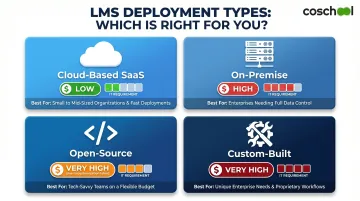
Schools encounter four main LMS types, each with different cost profiles, maintenance demands, and technical requirements: cloud-based (SaaS), on-premise, open-source, and custom-built. Understanding these differences helps narrow the field before evaluating specific vendors.
Cloud-Based (SaaS) LMS
Cloud-based LMSs are hosted by the vendor, accessible via browser, and require no server maintenance by the school. Schools pay subscription fees typically based on student count or institutional size. This model is the most practical choice for most K-12 schools, especially those with limited IT staff.
Cloud-based solutions account for 68% of K-12 deployments globally, with 72% of new contracts signed in 2024 being cloud-based. These platforms reduce IT maintenance time by approximately 35% annually, allowing technical staff to focus on instruction support rather than server management.
On-Premise LMS
On-premise LMSs are installed on the school's own servers, giving more control over data but requiring significant IT infrastructure, ongoing maintenance, and technical expertise. For schools with strict data localisation requirements, this control can be valuable. In practice, however, hardware and maintenance costs consume a substantial share of IT budgets, making this model difficult for most schools to justify.
Open-Source LMS
Open-source platforms like Moodle offer free access to source code and high customizability, but demand developer resources to set up, maintain, and update. While these platforms appear cost-effective initially, they require technical expertise that most schools lack, making total costs often exceed those of a comparable cloud solution once staffing and customisation expenses are factored in.
Custom-Built LMS
Custom-built solutions are developed from scratch for a specific institution's needs, offering maximum flexibility but requiring the highest upfront investment and long-term maintenance commitments. These work best for large school systems or educational chains with dedicated development teams.
Here's a quick comparison to orient your decision:
| LMS Type | Upfront Cost | IT Requirement | Best For |
|---|---|---|---|
| Cloud-Based (SaaS) | Low (subscription) | Minimal | Most K-12 schools |
| On-Premise | High | Extensive | Schools with strict data localisation needs |
| Open-Source | Low (licensing) | High (developer) | Tech-resourced institutions |
| Custom-Built | Very High | Dedicated team | Large school systems or chains |
Key Factors to Consider When Choosing an LMS for Your School
LMS selection for a school differs fundamentally from corporate or higher-education contexts because the users span multiple roles — teachers, students of varying ages, parents, and administrators — and the primary goal is learning outcomes, not just content delivery efficiency. The following factors help school decision-makers evaluate how well an LMS will serve their specific educational community beyond feature checklists.
K-12 Specific Design and Ease of Use
K-12 fit is non-negotiable. Many LMS platforms are built for corporate training or higher education, assuming high digital literacy from users — which does not reflect the reality of primary and secondary classrooms where both teachers and young students need intuitive interfaces.
Research on 388 K-12 teachers found only 10.3% felt prepared during the pandemic transition to digital tools, with familiarity and ease of use being primary drivers of tool selection. Teachers cited the frustration of learning to organize LMS platforms in a "user-friendly way" as a major hurdle.
The KPI this factor influences: teacher adoption rate and time-to-proficiency. If teachers find the system difficult, usage drops regardless of how feature-rich the platform is. Prioritize platforms designed specifically for K-12 with age-appropriate student interfaces and teacher-friendly content creation tools.
Adaptive Learning and AI Capabilities
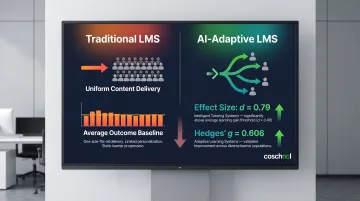
Beyond interface design, consider how the platform supports personalized learning. Evaluate whether an LMS can adjust lesson difficulty, pacing, and content recommendations based on each student's performance data in real time — so no student falls behind unnoticed.
The learning outcome metric at stake: knowledge gap reduction and student academic progress over time. Research shows that intelligent tutoring systems achieve effect sizes comparable to human tutoring (d = 0.79), while adaptive hypermedia learning systems demonstrate significant positive effects (Hedges' g = 0.606, a strong effect size) on academic performance. Platforms with AI-driven personalization — like Coschool's AI Tutor and real-time adaptive learning engine — can replicate meaningful aspects of 1:1 instruction at scale.
Parent and Teacher Engagement Features
A school LMS must bridge the home-school divide by giving parents visibility into their child's learning activity, progress, and areas of concern — not just end-of-term reports. Parental involvement is a well-documented driver of student success, but the type of involvement matters critically.
Meta-analysis of 55 studies (N = 106,221) found parental expectations have the strongest effect on achievement (r = 0.29), while parental control showed negative correlation (r = -0.10). This has direct design implications: parent portals should emphasize visibility and goal-setting, not surveillance.
Look for platforms that give teachers these communication capabilities directly within the LMS:
- Flag individual student learning concerns with parents in real time
- Share assignment updates and upcoming deadlines automatically
- Send curriculum-aligned resources for home reinforcement
- Track parent engagement to identify students lacking home support
This reduces communication friction and creates a consistent support structure around each student — which directly strengthens teacher effectiveness.
Integration with Existing School Systems
An LMS rarely operates in isolation. Schools need it to connect with their Student Information System (SIS), assessment tools, video conferencing platforms, and communication apps — and poor integration creates data silos that increase the administrative burden on teachers.
The operational KPI at stake: hours spent on manual data entry and reconciliation. Strong API connections reduce this significantly and ensure student performance data stays current across all systems. Evaluate vendors on API availability, supported integrations, and whether the platform follows open standards like LTI (Learning Tools Interoperability).
Data Privacy, Security, and Compliance
Schools handle sensitive data about minors — academic records, behavioral data, communication logs — and must ensure the LMS complies with applicable data protection regulations. In India, this includes the Digital Personal Data Protection Act (DPDP) 2023, which defines children as under 18 and requires verifiable parental consent for processing their data.
58% of school districts experienced at least one cyber incident in 2023 — and a non-compliant or breached LMS exposes the school to legal liability while eroding parent trust. Security evaluation is not optional.
Evaluate vendors on:
- Authentication protocols and access controls
- Data ownership clauses in contracts
- Backup and recovery procedures
- Where student data is hosted (Indian servers vs. international)
- Compliance with DPDP Act, including consent workflows
Total Cost of Ownership and Scalability
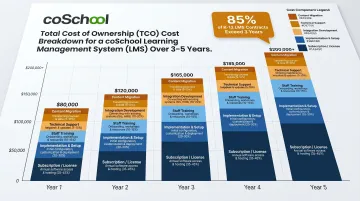
The sticker price of an LMS is rarely the full cost. Schools must factor in implementation fees, training costs, annual license increases, technical support charges, and integration expenses. A total cost of ownership (TCO) analysis over a 3–5 year horizon gives a far more accurate picture than the headline price.
Scalability matters just as much. 85% of K-12 LMS contracts exceed 3-year terms, and LMS system lifespans have increased by approximately 6 years, indicating significant lock-in. The platform you choose should grow with increasing enrollment, additional grade levels, and expanded subject offerings — without forcing a costly migration mid-cycle.
Hidden costs to consider:
- Maintenance and hosting fees
- Technical support charges (tiered by response time)
- Content migration expenses when switching platforms
- Staff training and onboarding
- Customization and branding fees
- Integration development costs
How Coschool Can Help Your School
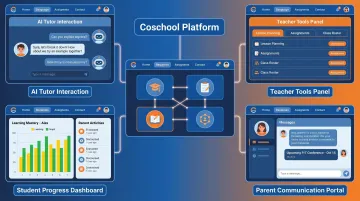
Coschool is an AI-first education platform built so no student is left behind. It brings together teacher empowerment tools, real-time adaptive learning, and parent engagement features in a single school solution.
Drawing on three decades of experience in education, Coschool uses Generative AI to deliver personalized 1:1 learning for every student. Unlike traditional LMS platforms that push content uniformly, Coschool adapts continuously to each learner's needs.
Coschool's differentiating capabilities relevant to school LMS selection include:
- Vin, India's first school-integrated AI tutor, delivers 24/7 personalized support using Socratic methodology
- Conversational learning at the platform's core means students learn through dialogue, not passive content consumption
- Adaptive learning engine identifies and closes knowledge gaps in real time, automatically
- Teacher AI Assistant generates classroom resources, question banks, lesson plans, and engagement tips on demand
- Parent portal provides real-time progress updates and direct communication channels between home and school
- DPDP Act compliant — student data hosted on Indian servers with verifiable parental consent workflows
Partner schools using Coschool's SchoolAI platform consistently reach class averages of 90-92% — an 8-12% improvement over baseline. Most schools without adaptive support plateau between 70-85%.
Conclusion
Choosing an LMS for a school is fundamentally a pedagogical decision — one that shapes classroom instruction, student progress, and how well parents stay connected to their child's learning. The right platform aligns with your school's teaching values and learning outcomes, not just its IT budget.
Schools should treat LMS selection as an evolving commitment, not a one-time purchase. Build in periodic reviews against three key indicators:
- Student learning outcomes — are knowledge gaps narrowing over time?
- Teacher adoption rates — is the platform saving time or creating friction?
- Parent engagement levels — are families more connected to school progress?
Given typical contract lengths of 3+ years, the initial choice carries real weight. But ongoing evaluation ensures the platform keeps serving the school's mission — and gives you a clear basis to upgrade or switch if it stops doing so.
Frequently Asked Questions
How do I choose the right learning management system for my school?
Assess your school's specific needs (K-12 fit, teacher capacity, student age range), define must-have features, evaluate vendors on adaptive learning capabilities, parent engagement tools, security compliance, and total cost of ownership. Always pilot the system with a small group of teachers and students before full rollout to identify adoption challenges early.
What are the four types of learning management systems?
The four main types are cloud-based (SaaS), on-premise, open-source, and custom-built. Cloud-based LMSs are generally best suited for K-12 schools because they require no server maintenance, offer browser-based access, and provide predictable subscription pricing — accounting for 72% of new K-12 contracts in 2024.
What features should a K-12 LMS have that are different from a corporate LMS?
K-12 LMSs require age-appropriate user interfaces for young learners, parent communication tools with real-time progress visibility, teacher-friendly content creation workflows, adaptive learning capabilities supporting diverse student needs, and compliance with child data protection regulations including India's DPDP Act — features absent from most corporate training platforms.
How long does it take to implement an LMS in a school?
Cloud-based SaaS platforms can be technically deployed in weeks, but thorough evaluation, staff training, content migration, and rollout planning for sustainable adoption typically takes 3–6 months for a full school.
Is a free or open-source LMS a good choice for schools?
Open-source LMSs like Moodle can appear cost-effective, but require developer resources for setup, customisation, security updates, and ongoing maintenance. For schools without dedicated IT staff, the hidden staffing and technical costs typically exceed those of a well-priced cloud-based solution.
How does an LMS support teacher empowerment and personalized student learning?
A well-designed school LMS reduces administrative burden by automating grading, progress tracking, and parent communication — freeing teachers for actual instruction. AI-enabled platforms go further, adapting content to each student's level so teachers can provide targeted support rather than one-size-fits-all delivery.