
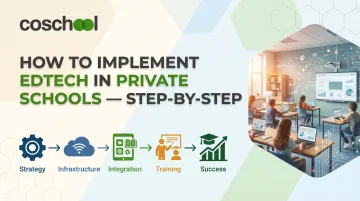
This guide is for private school principals, academic directors, IT coordinators, and management committees who want a structured, practical roadmap for EdTech adoption. It covers the complete, correct approach to implementing educational technology in private schools—from readiness assessment through sustained adoption—so you avoid costly mistakes and achieve genuine learning impact.
TL;DR
- Conduct a readiness assessment before purchasing any tool—evaluate infrastructure, teacher digital literacy, and stakeholder alignment
- Teacher buy-in and training determine implementation success — the tool choice matters far less
- A phased pilot-then-scale approach significantly reduces implementation failure risk
- Set goals around specific student learning outcomes, not vendor pitches or what neighbouring schools are adopting
- Don't overlook post-implementation monitoring, parent engagement, and tool consolidation once you go live
Before You Begin: Readiness Assessment for Private Schools
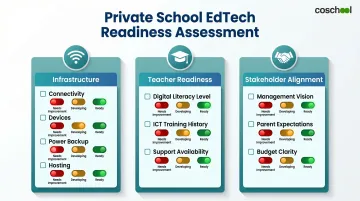
Start with an infrastructure audit before selecting any EdTech solution. Assess internet connectivity across all classrooms, power reliability, device availability (school-owned or BYOD), and whether existing systems can support a new platform.
According to UDISE+ 2024-25 data, only 58.0% of Indian schools have computers functional for pedagogy — and these are systemwide figures. Private schools face the same infrastructure gaps and need to audit honestly before any rollout begins.
Assess stakeholder readiness on three fronts:
- Teacher digital literacy: A 2025 study published in the Indian Journal of Educational Technology found that 38.8% of teachers in the sample had no computer experience, and only 11.3% had received ICT-related training. Major barriers included lack of technical support (52.5%) and inadequate training (47.5%). If your teachers fall into this category, plan for substantial professional development before rollout.
- Management alignment: Confirm leadership is aligned on a clear vision. Resistance or indifference at the management level can stall or derail rollout.
- Parent expectations: Understand what parents anticipate from EdTech. Misalignment between parental expectations and school capabilities creates pressure that undermines implementation.
EdTech implementation costs for Indian private schools depend on hardware, software licenses, training, and maintenance requirements. No authoritative India-wide benchmarks exist, so build your budget around:
- Networking and Wi-Fi upgrades across learning spaces
- End-user devices (tablets, laptops, or BYOD support infrastructure)
- Software licensing and subscriptions (annual or per-student fees)
- Teacher training and ongoing coaching
- Technical support and maintenance contracts
- Data privacy compliance (Digital Personal Data Protection Act, 2023)
Before finalising your budget, decide which implementation path fits your school's current capacity:
| Approach | What It Includes |
|---|---|
| Minimum viable setup | Limited pilot, affordable tools, basic connectivity, focused training |
| Full ICT investment | Comprehensive device coverage, robust networking, enterprise-grade software |
The EdTech Implementation Guide for Private Schools (Step-by-Step)
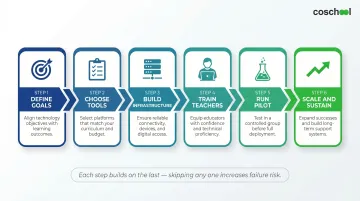
Successful EdTech implementation follows a deliberate sequence: define goals, select tools, build infrastructure, train staff, run a pilot, then scale. Each step builds on the last — shortcutting any one of them tends to surface as adoption failure or poor ROI later.
Step 1: Define Goals and Build a Shared Vision
Tie goals to specific, measurable student outcomes—not vague ambitions like "use more technology." Examples include:
- Reduce learning gaps in Math for Grades 5–8 by 15% within one academic year
- Improve teacher feedback turnaround to within 48 hours for all assignments
- Increase class averages from 75% to 85% across core subjects
- Reduce ninth-grade course failure rates by 20%
Research shows that goal-driven implementations outperform those without clear targets. A 2026 study published in PNAS found that increased class-level use of Khan Academy was associated with significant gains in math test scores, demonstrating that structured, outcome-focused EdTech use drives measurable improvement.
Run a structured stakeholder alignment session that includes teachers, management, and parent representatives. When the EdTech vision is co-owned across the school—not imposed top-down—adoption rates improve. Research on transformational leadership in schools confirms that principal leadership influences teacher beliefs and pedagogy, which are the strongest predictors of deeper technology integration.
Alignment session essentials:
- Present the specific academic problems EdTech will solve
- Share baseline performance data (current class averages, learning gap data)
- Invite teacher input on tool selection and implementation concerns
- Clarify roles and responsibilities for each stakeholder group
- Document agreed-upon success metrics and timelines
Step 2: Choose the Right EdTech Tools
Apply these selection criteria:
- Curriculum alignment: Does the tool support CBSE or ICSE curriculum frameworks? Content and assessments should map to your syllabus, not require teachers to adapt their teaching to fit the tool.
- Teacher usability: Can teachers operate the platform without extensive technical support? Complex interfaces increase resistance.
- Student-facing interactivity: Does the tool enable active learning, or is it passive content delivery? Meta-analysis shows that adaptive hypermedia learning systems significantly improve academic performance (Hedges g ≈ 0.606, p<0.001) compared to traditional methods, while passive screen use can hinder learning.
- Reporting and analytics capability: Does the platform provide actionable insights—such as learning gap identification, engagement metrics, and progress tracking—that teachers and administrators can use to inform instruction?
- Data privacy compliance: Ensure the tool adheres to the Digital Personal Data Protection Act, 2023 and the Information Technology Act, 2000.
- Vendor implementation support: Does the vendor provide onboarding, training, and post-deployment support, or are you on your own after purchase?
AI-powered adaptive platforms like Coschool are built around closed-loop learning: student performance data informs teacher action, which feeds back into student support. This real-time cycle — rather than static content delivery — is what drives measurable outcomes.
Platforms that combine personalized learning, teacher-facing analytics, and parent communication in one system outperform point solutions that address only one of those needs.
Avoid tool selection driven by admissions marketing pressure or competitor school choices. Many schools buy EdTech to attract parents rather than improve learning, leading to low adoption and poor ROI. Outcomes-based contracting ties payments to student results and reports higher implementation quality—a model private schools can adopt by piloting tools and scaling only when measurable outcomes are achieved.
Step 3: Build or Upgrade Your Infrastructure
Minimum infrastructure requirements for a functional EdTech classroom:
- Stable Wi-Fi across all learning spaces: Coverage must extend to every classroom where EdTech will be used, not just administrative areas.
- Adequate devices per student: Whether school-owned or BYOD, ensure sufficient devices to avoid bottlenecks. No authoritative India-specific device ratio exists, but plan for at least 1:2 (one device per two students) for shared use or 1:1 for full integration.
- Power backup systems: Frequent power disruptions erode teacher and student confidence. UPS systems or generators are essential in areas with unreliable electricity.
- Secure cloud or server hosting: Student data must be encrypted in transit and at rest, with access controls and regular security evaluations.
Design infrastructure for future scale, not just current enrolment. If you pilot with 100 students but plan to scale to 500, your network and server capacity must handle peak load.
Essential conditions for effective technology use, as outlined by ISTE, include leadership, professional learning, technical support, equitable access, and data interoperability. Infrastructure is not just hardware—it's the ecosystem of support that enables sustained use.
Step 4: Train Teachers and Staff
Teacher training is where EdTech implementations succeed or stall. Research shows that continuous, content-focused professional development with coaching outperforms one-off workshops for improving teacher practice with digital tools — and the difference in adoption is substantial.
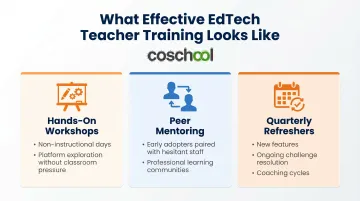
Effective training includes:
- Hands-on workshops during non-instructional working days: Teachers need time to explore the platform without classroom pressures.
- Peer mentoring: Identify early adopters and pair them with hesitant staff. Professional learning communities and coaching are critical to shifting classroom practice.
- Structured refresher sessions: Not a one-time onboarding. Schedule quarterly refreshers to introduce new features and address ongoing challenges.
Training must address pedagogy—how to teach more effectively using the tool—not just how to operate the software. For example, if the platform provides adaptive learning, train teachers on how to interpret learning gap data and design targeted interventions, not just how to log in and assign homework.
The NCERT study cited earlier found that lack of technical support (52.5%) and inadequate training (47.5%) were the top barriers to teacher adoption. Address both by providing ongoing technical help desks and embedding training into regular professional development cycles.
Step 5: Run a Controlled Pilot
Structure your pilot carefully:
- Select 2–3 grade levels or subject areas: Start small to prove value before scaling.
- Define success metrics in advance: Usage rates (% of teachers actively using the tool weekly), student engagement signals (time on task, assignment completion), teacher feedback (qualitative surveys), and early learning impact signals (assessment data compared to baseline).
- Build in a formal feedback collection mechanism: Use surveys, focus groups, and interviews with teachers, students, and parents to understand what's working and what needs adjustment.
Digital Promise's Edtech Pilot Framework recommends an 8-step process from problem definition to analyze-and-decide, emphasizing predefined goals, training, and mixed-methods data collection. Scope and duration should be set to capture quantitative and qualitative evidence against goals—typically 1–3 months for initial pilots.
Monitor actively during the pilot:
- Are teachers using the tool consistently, or only sporadically?
- Are students engaging with the platform, or bypassing it?
- Are there device or connectivity failures that disrupt use?
- Are early learning impact signals visible in formative assessment data?
Pilots reduce risk. Outcomes-based contracting pilots tie payments to agreed metrics, improving implementation rigor and reducing the risk of poorly adopted tools.
Step 6: Scale, Integrate, and Sustain
Transition from pilot to school-wide rollout:
- Strengthen infrastructure for greater load: Ensure Wi-Fi, devices, and support systems can handle increased usage.
- Formalize responsible use policies: Establish acceptable use policies for students and teachers, aligned with data privacy regulations.
- Expand professional development: Train remaining staff using lessons learned from the pilot. Leverage early adopters as champions.
- Integrate EdTech data with school reporting and parent communication systems: Real-time progress updates and parent portals improve transparency and accountability. Research shows that parent portal usage correlates with lower ninth-grade course failure rates and improved attendance.
Sustaining adoption operationally:
- Set KPIs: Teacher active usage rates, student engagement metrics (task completion, time-on-platform), academic performance trends vs. baseline, parent satisfaction data.
- Review dashboards quarterly: Assign an internal champion (IT head or academic coordinator) responsible for monitoring and reporting.
- Build a culture where analytics inform teaching decisions: Don't let data sit unused in admin portals. Use real-time insights to drive instructional adjustments, targeted interventions, and continuous improvement.
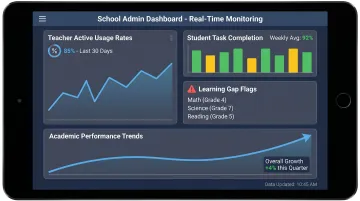
Platforms like Coschool provide analytics dashboards that flag students with learning gaps in real time, enabling teachers to act immediately rather than waiting for term-end assessments.
Post-Implementation Checks and Validation
Track these indicators to confirm your EdTech rollout is gaining real traction:
- At least 70% of teachers using the platform weekly for core instructional activities
- Student time on task, assignment completion rates, and active participation in platform activities
- Class average trends compared to pre-implementation baselines — are learning gaps closing?
- Parent-reported visibility into their child's progress and learning milestones
These indicators only matter if they drive action. Use the platform's analytics and reporting capabilities to adjust instruction before gaps compound. AI-driven insights that flag struggling students in real time enable faster, targeted interventions. The PNAS study on Khan Academy found that structured weekly practice on a digital platform can improve math outcomes at scale — evidence that formative, ongoing data supports better decisions than waiting for term-end results.
Establish a quarterly review cycle with a designated internal champion responsible for monitoring and reporting. Skipping formal post-launch evaluation is one of the most common reasons EdTech adoption collapses. Regular reviews keep stakeholders accountable and ensure the platform continues delivering value over the long term.
Common Implementation Challenges and Fixes
Challenge 1: Teacher Resistance and Low Adoption
Teachers often perceive EdTech as extra workload, a threat to their role, or a change imposed without their input. Getting buy-in early is what separates a smooth rollout from a stalled one.
- Involve teachers in tool selection from the start
- Provide adequate practice time before expecting classroom use
- Identify internal early adopters to serve as peer champions
- Demonstrate time savings directly — show how automated grading or lesson planning support reduces their load, not adds to it
The NCERT study identifies lack of technical support and training as top barriers. Provide ongoing help desks and structured coaching to reduce resistance.
Challenge 2: Infrastructure Gaps That Surface Mid-Rollout
Schools routinely underestimate bandwidth needs or device availability. Once multiple classrooms attempt simultaneous use, disruptions follow — and a single bad week can set back adoption by months.
- Complete infrastructure upgrades in priority classrooms before any tool goes live
- Test under realistic load conditions during the pilot phase before committing to full deployment
- Establish a technical support team with clear response times so issues don't linger
Infrastructure failures and teacher resistance feed each other. Fixing one without the other leaves the rollout vulnerable.
Challenge 3: High EdTech Spend with No Improvement in Learning Outcomes
Schools invest in hardware and software subscriptions, yet student performance data often shows no meaningful change. The most common reason: tools are used passively — as digital textbooks — rather than as interactive learning instruments.
- Shift the focus from tool deployment to pedagogy — are students actively participating, or just watching?
- Choose platforms with real-time analytics and adaptive learning rather than static content libraries
- Track engagement signals (time on task, assignment completion) and step in when passive use patterns appear
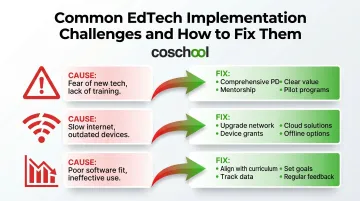
A meta-analysis of adaptive hypermedia systems found significant improvements in learning outcomes — while the same body of research found that passive screen time, without interaction or feedback, produced no measurable gains.
Pro Tips for Successful EdTech Implementation in Private Schools
Start small and prove value before scaling. A well-monitored 3-month pilot in 2 classrooms generates more genuine stakeholder buy-in than a rushed school-wide launch that underdelivers on expectations.
Make parent visibility a deliberate part of your EdTech strategy from day one. Schools that use technology to give parents real-time access to attendance, progress reports, and teacher feedback see stronger parent trust and student accountability. Research confirms that parent portal access and communication nudges associate with lower odds of ninth-grade course failure and improved attendance.
Audit and consolidate your tool stack regularly. Using too many disconnected tools creates confusion for teachers and students. Aim for integrated platforms rather than a patchwork of apps. Reporting highlights that fragmented app setups burden both parents and teachers, reducing engagement across the board.
EdTech success requires sustained leadership commitment. A principal or director who stays visibly involved shapes how seriously teachers and staff take the rollout. Research confirms that leadership engagement directly influences teacher motivation and school-wide adoption rates.
Practical ways to stay involved:
- Attend teacher training sessions alongside staff
- Review analytics dashboards at least once a month
- Publicly acknowledge classrooms or teachers showing strong adoption
Frequently Asked Questions
What is the 70/30 rule in teaching?
The 70/30 rule structures learning so that 70% of classroom time is student-driven (practice, exploration, problem-solving) and 30% is direct instruction. EdTech tools support this balance by enabling self-paced and adaptive learning that shifts time away from teacher-led lectures toward active student engagement.
How long does EdTech implementation take in a private school?
A pilot phase typically takes 1–3 months, while full school-wide rollout can take 6–18 months depending on school size, existing infrastructure readiness, and training requirements. Rushing the timeline increases failure risk.
What is the biggest challenge in implementing EdTech in Indian private schools?
Teacher resistance and infrastructure gaps are the two most common barriers. Both are manageable through phased rollout, dedicated teacher training, and infrastructure upgrades planned before each new deployment stage.
How do you measure the success of EdTech implementation in schools?
Track four core areas: teacher usage rates (weekly platform activity), student engagement (task completion, time-on-platform), academic performance against your pre-implementation baseline, and parent satisfaction from periodic surveys.
How much does EdTech implementation cost for a private school in India?
Costs vary widely for Indian private schools — from free or low-cost tools (₹0–₹500 per student/year) to full ICT infrastructure investments. Run a needs and budget assessment first, then prioritize connectivity and teacher training before committing to a larger rollout.
Can small private schools with limited budgets implement EdTech effectively?
Yes—by starting with affordable tools, focusing investment on teacher training first, and scaling only after demonstrating measurable outcomes from a small pilot. Outcomes-based contracting and phased rollouts reduce financial risk.