

Introduction
Pass percentage is one of the most visible metrics by which schools are evaluated — and most schools only act on it after results drop. The scramble that follows (extra classes, mock tests, last-minute remediation) rarely addresses why students failed in the first place.
The reasons students fail vary widely: cumulative learning gaps, ineffective teaching methods, disengaged parents, and the absence of early warning systems that flag at-risk students before exams begin. These are structural problems — not problems that an extra revision class can fix.
The scale of the challenge is hard to ignore. According to Union Education Ministry data, over 65 lakh students failed Class 10 and 12 board exams in 2023 across all boards in India. State board students experienced failure rates of 16% (Class 10) and 18% (Class 12) — roughly two to three times higher than CBSE's 6% and 12%.
This guide walks school leaders and teachers through the root causes of low pass rates, a step-by-step improvement plan, the key variables that determine success, and the common pitfalls to avoid.
TLDR
- Improving pass percentage requires diagnosing root causes first — not just adding revision hours or mock tests
- Early identification of at-risk students, before exams begin, is the highest-leverage action schools can take
- Instructional approach, not just student effort, is often the biggest lever — particularly for borderline students
- Schools that improve consistently pair structured performance tracking with personalised support for students who need it most
- Parent engagement must run continuously — not just during exam season — to have any real impact
Why Student Pass Percentages Fall Short: Root Causes Schools Must Diagnose First
Pass rate problems almost always have multiple overlapping causes. Launching interventions without diagnosing the source leads to wasted effort. Schools need a diagnostic lens, not a one-size-fits-all solution.
Learning Gaps Carried Forward
Students who missed foundational concepts in earlier grades enter higher classes already behind, compounding into failure at exam time. This pattern is especially common in maths and science.
ASER 2022 data reveals the scale of this problem in India:
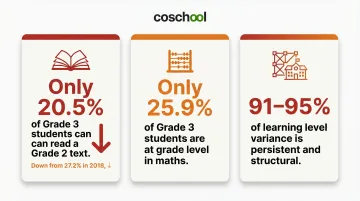
- Only 20.5% of Grade 3 students in rural India could read a Grade 2 text — down from 27.2% in 2018
- Only 25.9% of Grade 3 children were at grade level in maths, and just 21.6% of Grade 5 students could do basic division
- In government schools, only 38.5% of Grade 5 students could read a Grade 2 text
Research confirms these gaps don't disappear on their own. A peer-reviewed analysis found that 91-95% of variance in state learning levels is persistent and structural, not transient. Curricula move at a pace designed for top-tier students, leaving the majority behind each year.
Weak Early Warning Systems
Many schools only identify failing students after mid-term or pre-final results. By then, there's little time for recovery. McKinsey's 2007 study found that students placed with low-performing teachers for several years suffer "educational loss which is largely irreversible."
Schools with effective early warning systems flag at-risk students based on:
- Real-time class performance and assignment completion
- Attendance patterns and behaviour indicators
- Formative assessments conducted throughout the year
Catching struggling students in Week 4 of a term leaves room for targeted support. Catching them in Week 18 leaves room only for damage control.
Instructional Mismatch
Even when early warning systems are in place, the teaching method itself can be the problem. In lecture-heavy classrooms, students who learn at different paces or through different modalities disengage and fall behind without anyone noticing.
The data backs this up. A meta-analysis of 225 STEM studies published in PNAS found that failure rates dropped from 33.8% under traditional lecturing to 21.8% under active learning — a reduction of more than one-third. Students in traditional lecture courses were 1.5 times more likely to fail.
Low Parent Visibility
In households where parents have limited visibility into daily academic progress, problems go unaddressed at home. A meta-analysis of 37 studies found that high parental academic expectations had the strongest effect on student achievement (r = 0.22), while homework help can sometimes be slightly negative (r = -0.11).
What moves the needle is parents staying informed about their child's progress and holding consistent academic expectations at home.
How to Improve Student Pass Percentage: A Step-by-Step School Guide
Step 1: Conduct a Subject-wise and Student-level Performance Audit
Start with data. Pull pass/fail rates broken down by:
- Subject (which subjects show highest failure?)
- Class section (are failures concentrated in specific teachers' classes?)
- Student demographics (are patterns emerging by gender, previous performance, or attendance?)
Define clear benchmarks:
- Danger zone: Students scoring below 40%
- Borderline: Students scoring 40-55%
- On track: Students scoring above 55%
Intervention strategies should differ for each group. Borderline students offer the highest return on effort — a relatively small improvement can move them from failing to passing.
Step 2: Build Individual Intervention Plans for At-Risk Students
At-risk students need structured, time-bound plans specifying:
- Which topics they need to cover
- How they will receive support (extra classes, peer tutoring, remedial sessions)
- Who is accountable for monitoring their progress
Prioritise borderline students. Moving a student from 48% to 56% is far more achievable than moving a danger-zone student from 22% to 40% in the same timeframe. Allocate resources accordingly.
Schools using platforms like Coschool report 8-12% increases in class averages by implementing structured intervention systems that track individual student progress and provide targeted support.
Step 3: Redesign Classroom Instruction for Better Retention
Shift from passive learning (students listening, copying notes) to active learning (students solving, questioning, discussing).
Freeman et al.'s research found that active learning raised average exam scores by 0.47 standard deviations — approximately six percentage points, equivalent to a half-letter-grade improvement.
Practical classroom changes include:
- Breaking lessons into smaller chunks with frequent checks for understanding
- Dedicating 60-70% of class time to student activity (problem-solving, group work, discussion) rather than teacher lecture
- Providing immediate feedback so students don't carry forward misunderstandings
- Using low-stakes in-class quizzes to identify gaps before summative exams
Step 4: Implement Personalised and Adaptive Learning Support
Remediation works best when it meets each student where they actually are, not where the curriculum assumes they are. Personalised learning paths fill specific knowledge gaps rather than repeating content that didn't work the first time.
The challenge: Delivering one-on-one support across a full classroom isn't feasible through teacher effort alone. Platforms like Coschool address this using Generative AI — Vin, the AI Tutor, delivers real-time adaptive learning and conversational tutoring to each student individually, making personalised support viable even in large classes with many at-risk students.
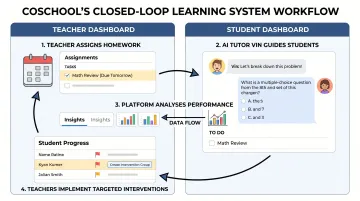
The system works through a closed loop:
- Teachers assign homework through the platform
- Vin guides students with personalised, Socratic questioning during assignments
- The platform analyses performance and shares actionable insights with teachers
- Teachers implement targeted interventions based on data
Step 5: Activate Parents and Establish Continuous Progress Monitoring
In-school support only goes so far. Structured parent communication — frequent, topic-level updates rather than end-of-term report cards — creates a home-school reinforcement loop that improves attendance, homework completion, and exam readiness.
Set up a monitoring cadence: Weekly or bi-weekly checks on at-risk students' progress against their intervention plan. This ensures schools can course-correct before it's too late.
Parents should receive:
- Topic-level progress updates (not just overall grades)
- Specific areas where their child is struggling
- Clear actions they can take to support learning at home (setting expectations, ensuring dedicated study time)
Key Factors That Determine Whether Your Improvement Plan Will Work
Two schools can follow the exact same improvement plan and land at opposite ends of the results spectrum. The difference usually comes down to a handful of execution factors that schools routinely underestimate.
Teacher Buy-in and Capacity
Improvement plans fail when teachers see them as additional administrative burden. Short, practical professional development — tied directly to classroom application — gives teachers both the skills and the confidence to try new approaches without feeling overloaded.
Hanushek & Rivkin's research found that a teacher at the 75th percentile vs. the 25th percentile produces a learning gain difference of 0.2 standard deviations per year — enough to move a student from the 50th to the 58th percentile. Teacher quality variation "completely dominates" the effect of class size reduction.
Timeliness of Intervention
Once teachers are equipped to act, timing becomes the next critical variable. Early identification — ideally within the first quarter of the academic year — gives schools maximum runway to close learning gaps before high-stakes exams.
The McKinsey study establishes that delayed identification and intervention leads to compounding, permanent damage. Students assigned three effective teachers vs. three ineffective teachers diverged by 49 percentile points over three years. Each quarter of delay compounds the deficit.
Quality of Assessment Data
Schools relying only on summative exams (unit tests, half-yearlies) work with delayed, low-frequency data. Frequent formative assessments — even quick in-class checks — give teachers real-time signals to adjust instruction before students fall too far behind.
Black & Wiliam's landmark study found that formative assessment produces effect sizes between 0.4 and 0.7 — "larger than most of those found for educational interventions."
Consistency of Execution
Pass percentage is a lagging indicator — it takes months of consistent effort before results surface. Schools that abandon interventions mid-year after seeing no immediate movement often see worse outcomes than schools that stayed consistent.
A useful internal checkpoint: track leading indicators (attendance at remedial sessions, formative scores, teacher observation notes) rather than waiting for exam results to validate the plan.
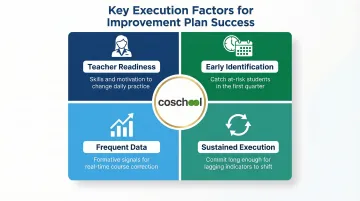
To summarize, the four factors that most reliably separate successful improvement plans from stalled ones:
- Teacher readiness — skills and motivation to change daily practice
- Early identification — catching at-risk students in the first quarter, not the last
- Frequent data — formative signals that allow course correction in real time
- Sustained execution — committing to the plan long enough for lagging indicators to shift
What Schools Need in Place Before Starting an Improvement Plan
Improvement plans fail not from lack of effort, but from missing foundations. Before launching any initiative, three things must be in place: reliable data, aligned leadership, and targets grounded in where the school actually stands.
Data and Systems Readiness
Minimum infrastructure required:
- Subject-wise performance records at the student level
- Attendance data and assignment completion tracking
- A way to track intervention progress — whether digital or manual
Schools using learning management systems or analytics platforms have an advantage, but even structured spreadsheets work if updated consistently.
Teacher and Leadership Alignment
Once data systems are ready, leadership alignment is the next non-negotiable. Principals and academic heads must agree on goals, strategy, and roles before any of it reaches classroom teachers. Fragmented messaging from the top derails even well-designed plans.
Key alignment questions:
- What is our realistic pass rate target this year?
- Which subjects are our highest priority?
- What support will teachers receive to implement new approaches?
- How will we measure progress mid-year?
Realistic Timeline Setting
Setting unrealistic goals leads to demoralisation and plan abandonment. Use current pass rates to calibrate ambition.
Suggested one-year targets:
- 60–70% pass rate: aim for 5–8 percentage point improvement
- 75–85% pass rate: aim for 3–5 percentage point improvement
- Above 85%: shift focus to reducing failure in specific weak subjects, not aggregate improvement
Common Mistakes Schools Make When Trying to Boost Pass Rates
Treating All Failing Students the Same
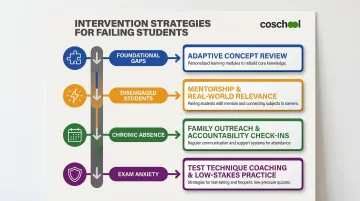
One remedial class for every struggling student is rarely enough. A student failing because of foundational gaps needs entirely different support than one who's checked out, chronically absent, or freezing up during exams.
Differentiate interventions:
- Identify foundational gaps early and assign adaptive concept review — not generic revision worksheets
- Re-engage disengaged students through mentorship, real-world relevance, and small wins
- Address chronic absence through family outreach and accountability check-ins
- Coach exam-anxious students on test technique and build confidence through low-stakes practice
Focusing Only on Exam Preparation, Not Learning
A common reflex when pass rates drop is to pile on more practice papers and mock tests. This builds test-taking familiarity but doesn't fix the root cause — students fail because they don't understand the concepts being tested, not because they lack exposure to question formats.
Ignoring the Teacher Variable
Improvement efforts tend to land on students and parents. What gets overlooked is that inconsistent or ineffective instruction in specific subjects is frequently the primary driver of failure.
McKinsey's research found that students with high-performing teachers progress three times as fast as those with low-performing teachers. Reducing class size from 23 to 15 improves performance by eight percentile points at best. A high-performing teacher? Fifty points.
If failures are concentrated in specific teachers' sections, the solution isn't student remediation — it's teacher coaching.
Frequently Asked Questions
How to improve student pass percentage in school?
Conduct a performance audit to identify at-risk students early, redesign classroom instruction toward active learning and formative assessment, and track progress continuously throughout the year. Focus interventions on borderline students (40-55%) for highest impact.
What is the 70/30 rule in teaching?
The 70/30 principle suggests dedicating 70% of classroom time to student activity (practice, discussion, problem-solving) and 30% to teacher-led instruction. This shift improves retention and builds genuine understanding rather than passive recall.
What are the 5 C's of student engagement?
Doug Reeves' 5 C's framework identifies five classroom engagement drivers:
- Connection — trust between student and teacher
- Conditions — a psychologically safe learning environment
- Collaboration — structured group work and peer learning
- Challenge — intellectual stretch appropriate to the student
- Control — student agency within a defined structure
How do you identify students at risk of failing before exams?
Monitor early indicators: consistent low scores on classwork, high absenteeism, incomplete assignments, and failure to demonstrate concept mastery in formative checks. These signals should trigger intervention in the first academic quarter, not weeks before exams.
How does technology help improve student pass percentage?
EdTech tools enable real-time performance tracking, personalised learning paths, and stronger parent-teacher communication. AI-powered platforms like Coschool can deliver adaptive, one-on-one-style tutoring to hundreds of students at once — scaling the support that teachers alone cannot provide.
A note before you go: Pass rates improve when schools treat them as a year-round process outcome. Schools that build systems to identify struggling students early, personalise support at scale, and keep teachers, students, and parents aligned throughout the year consistently see better results than those scrambling in the final weeks before exams.