Introduction
Indian schools are demanding more from their EdTech platforms. Beyond content libraries and video lessons, administrators now seek AI-first solutions that serve teachers, students, and parents together within a unified ecosystem. A 2026 survey found that 35% of edtech users in India's schools now use GenAI tools, signaling a clear shift toward intelligent, adaptive learning technologies.
Extramarks has built significant scale—serving over 15,000 schools, 320,000 teachers, and 10 million students across CBSE, ICSE, and state boards. Yet many school administrators report persistent gaps:
- Limited personalization beyond basic content recommendations
- Weak teacher tools for real-time classroom support
- Minimal parent engagement built into the platform
- Inconsistent support when rolling out school-wide programs
This article covers the best AI-powered Extramarks alternatives built specifically for schools — platforms that go beyond recorded content to deliver institution-wide, adaptive learning aligned with NEP 2020's focus on competency-based education.
TL;DR
- Extramarks covers content at scale but falls short on personalization, teacher tools, and parent engagement
- Strong alternatives are judged on adaptive learning, teacher support, parent features, and school-wide scalability
- Coschool is the top pick — built entirely on Generative AI with a 1:1 learning model for every student
- Other notable alternatives include BYJU's for Schools, Teachmint, Classplus, and iDream Education
- Choose a platform that closes learning gaps and empowers educators — not just one with the most content
Why Schools Are Looking Beyond Extramarks
Extramarks brings real strengths to the table: a massive content library covering CBSE, ICSE, NCERT, and major state boards, plus partnerships with over 15,000 schools nationwide. These numbers establish the platform as a widely adopted school solution with proven reach and board-aligned curriculum coverage.
These strengths, however, don't fully address what schools need post-NEP 2020. School administrators consistently report the same gaps:
- No true adaptive learning path for individual students beyond basic content recommendations
- Limited tools for teachers to personalize instruction in real time
- No meaningful home-school communication loop to keep parents informed and engaged
The platform's AI layer remains primarily recommendation-based rather than conversational or generative.
The Indian EdTech landscape has shifted since NEP 2020 called for formative, adaptive assessment to individualize each student's learning journey. Schools now need platforms that use AI not just for content delivery, but for identifying and closing individual student knowledge gaps. Most schools plateau at 70–85% average scores; breaking through requires AI that adapts in real time, not one that simply surfaces more videos.
Best Extramarks Alternatives for Schools — AI-Powered Platforms
Platforms below were selected for their AI depth, school-level functionality (not just student apps), Indian curriculum compatibility, and ability to serve teachers, students, and parents within a single ecosystem.
Coschool
Coschool is an AI-first education platform built on Generative AI, with three decades of education experience behind its founders. It's purpose-built to empower teachers, deliver adaptive 1:1 learning to every student, and bridge school and home through active parent engagement.
Its AI-driven tools — Vin AI Tutor and AI Assistant — enable a virtual 1:1 teacher-student ratio across an entire classroom. Teachers receive customizable, real-time classroom resources: lesson plans, question banks, engagement tips, and documentation support. Real-time adaptive learning closes knowledge gaps before they compound, with schools reporting 8–12% increases in class averages.
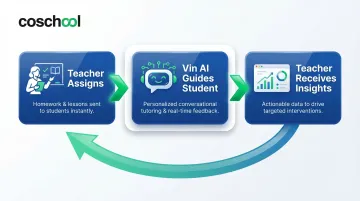
Unlike content-heavy competitors, Coschool emphasizes learning through conversation at its core. Vin employs a guided Socratic approach, building genuine understanding rather than simply providing answers. Teachers assign homework through the platform, Vin guides students during practice with personalized feedback, and teachers receive actionable insights to implement targeted interventions — completing a closed-loop learning system.
| Key Features | AI Tutor (Vin), AI Assistant, real-time adaptive learning, customizable teacher resources, parent engagement tools |
|---|---|
| Best For | Schools seeking a Generative AI-native platform that empowers teachers while personalizing student learning and involving parents |
| AI Approach | Generative AI-powered conversational learning; learning through dialogue at the core of the student experience |
BYJU's for Schools
BYJU's for Schools (formerly BYJU's Smart Class) represents one of India's largest EdTech players offering school-level content delivery, AI-enabled adaptive assessments, and multimedia-rich lessons aligned to CBSE, ICSE, and state boards. In 2023, BYJU's launched BYJU's Wiz, a suite of AI models for hyper-personalized learning, though its application in the schools product remains primarily content-focused.
Scale and brand recognition are real advantages — the platform carries established credibility with thorough board-aligned curriculum coverage. In practice, though, the AI layer handles recommendations and adaptive testing rather than deep conversational or generative learning, and teacher-facing tools are less developed than student-facing features.
Schools should also weigh the platform's ongoing insolvency proceedings when assessing long-term partnership reliability.
| Key Features | Adaptive assessments, AI-driven learning recommendations, video lessons, curriculum-mapped content |
|---|---|
| Best For | Schools wanting established brand credibility with AI-assisted content delivery and board-aligned curriculum |
| AI Approach | Recommendation-based AI and adaptive testing; less generative/conversational |
Teachmint
Teachmint (operating as an integrated school platform) combines school ERP, attendance, fee management, and a digital classroom layer with AI features increasingly embedded in lesson planning and student performance tracking. With ₹49.3 Cr+ revenue in FY24 and serving 4,000+ educational institutes, Teachmint has established strong presence in the Indian school technology market.
The platform's strength lies in operational efficiency for school administrators and teacher ease-of-use. It consolidates multiple school functions into one system, reducing fragmentation. That said, the AI layer currently skews toward management analytics and administrative support rather than deep personalized student learning — a tradeoff worth evaluating against your school's priorities.
| Key Features | School ERP, digital classrooms, AI-assisted lesson planning, attendance and fee management, teacher tools |
|---|---|
| Best For | Schools wanting an all-in-one school management + teaching platform with improving AI capabilities |
| AI Approach | AI used for administrative analytics and lesson support; adaptive student learning is less developed |
Classplus
Classplus is a teacher-first platform enabling schools and educators to create, manage, and deliver digital courses with built-in communication tools, test creation, and performance analytics. With ₹142.8 Cr+ revenue in FY24, Classplus has demonstrated strong growth, primarily among coaching institutes and individual educators expanding into school chains.
AI features focus on test analytics and content recommendations. The platform excels as a teacher empowerment tool with strong parent communication capabilities, app branding options, and course builder functionality. For real-time conversational AI tutoring or individualized student learning paths, though, supplementary tools would be needed alongside this platform.
| Key Features | Course builder, test management, performance analytics, teacher-parent communication, app branding |
|---|---|
| Best For | Schools and school chains prioritizing teacher-driven digital content delivery and strong parent communication |
| AI Approach | AI used for performance analytics and content suggestions; real-time adaptive learning is limited |
iDream Education
iDream Education is an AI-adaptive learning platform designed for Indian schools, especially focused on foundational literacy, numeracy, and multilingual learning. The platform offers 10+ content formats in bilingual interface plus 10 regional languages, with NEP/NCERT/state-aligned content and offline compatibility.
Strength lies in adaptive learning paths and learning gap identification through its iPrep PAL (Personalized Adaptive Learning) offering, making it relevant for schools serving diverse student abilities or limited infrastructure settings. Teacher and admin dashboards provide detailed progress analytics. In contrast, teacher empowerment features and parent engagement tools are less developed compared to more comprehensive platforms. Schools in tier-2/3 markets or government settings with multilingual needs will find this relevant.
| Key Features | AI-adaptive learning paths, multilingual support, foundational learning focus, offline compatibility |
|---|---|
| Best For | Schools with diverse student abilities or limited infrastructure needing adaptive, multilingual AI learning |
| AI Approach | Adaptive AI that maps student learning levels and adjusts content difficulty; strong in foundational stages |
How We Evaluated These Platforms
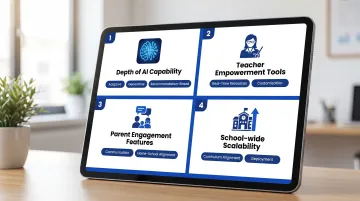
Platforms were evaluated across four dimensions specifically relevant to schools:
- Depth of AI capability — adaptive, generative, or recommendation-based
- Teacher empowerment tools — real-time resources and classroom customisation
- Parent engagement features — communication depth and home-school alignment
- School-wide scalability — curriculum alignment and deployment ease
Schools frequently make avoidable selection errors. The most common:
- Choosing based on brand recognition or content volume alone
- Overlooking whether the platform actually reduces teacher workload
- Not distinguishing between substantive AI features and surface-level ones
UNESCO's 2023 guidance for generative AI in education emphasizes human-in-the-loop design, tool validation, data privacy, and explicitly frames AI as augmenting teachers—not replacing them. That benchmark matters: a platform should demonstrate measurable learning outcomes, not just engagement metrics. HolonIQ's 2026 education trends reinforce this, noting a clear shift from AI experimentation to governed, verifiable AI embedded in workflows with evidence of instructional benefit.
Schools should request demos that specifically test adaptive learning depth, teacher resource customisation, and parent communication features before committing.
Conclusion
Extramarks is a functional platform with large-scale content and established partnerships. But schools seeking genuine AI-powered transformation — personalised student support, empowered teachers, and engaged parents — need to evaluate platforms where AI is central to the learning design, not bolted on as an afterthought.
Prioritise platforms where AI is foundational, not an add-on. Request demos that test adaptive learning depth, teacher resource customisation, and parent engagement features. Ask vendors to show evidence of measurable learning outcomes, not just feature lists.
For schools ready to move from content delivery to true personalised learning, Coschool brings together a conversational AI tutor (Vin), real-time adaptive learning, and teacher resource tools — all built around one goal: no student gets left behind. See it in action at coschool.ai.
Frequently Asked Questions
What are the biggest limitations of Extramarks for schools?
Limited true personalization beyond content recommendations—no 1:1 adaptive learning paths. Teacher empowerment tools remain basic beyond content delivery. School administrators report mixed support experiences, and parent engagement features are minimal, with no meaningful home-school communication loop.
What makes a platform truly AI-powered versus just using AI as a label?
Genuine AI includes generative, adaptive, and conversational capabilities—not just search or recommendations. Ask vendors to demonstrate real-time adaptive learning that responds to individual student gaps, teacher dashboards with actionable insights, and AI that personalises instruction beyond initial setup.
How is Coschool different from Extramarks for schools?
Coschool is Generative AI-first with a 1:1 virtual learning model enabled by Vin AI Tutor. It emphasises learning through conversation, not content consumption. Teachers receive customisable resources in real time, and the platform connects teachers, students, and parents in a closed-loop system — unlike Extramarks' content-library approach.
Can AI-powered platforms support all K-12 grade levels?
Most modern AI-powered school platforms support K-12 and adapt difficulty by grade level. However, schools should verify specific board alignment (CBSE, ICSE, state boards) and request demos for the exact grades they serve before finalising selection.
How does adaptive learning specifically help classroom teachers?
Adaptive learning platforms give teachers real-time data on individual student knowledge gaps, enabling targeted interventions without manual one-on-one assessment of every student. This lets teachers focus on high-value facilitation while AI handles personalisation and progress tracking.
Will an AI platform replace teachers in schools?
No. AI platforms augment teachers by handling personalisation, doubt-solving, and progress tracking, freeing them for mentorship and higher-order facilitation. UNESCO guidance explicitly emphasises keeping humans in the loop and warns against "teacher-proof" automation.