Introduction
Teachers work far beyond their contracted hours, and the data proves the scale of this crisis. Indian school teachers work an average of 48 to 55 hours per week, well above contracted hours, driven largely by administrative tasks, lesson preparation, and manual assessment cycles. NCERT studies and state-level education surveys consistently show that a significant share of this time is spent on work that never directly reaches students. Globally, the pattern holds: chronic overload driven by manual, repetitive tasks. That's a structural problem technology can meaningfully address.
The impact extends beyond exhausted teachers. Burnout fuels attrition that destabilizes classrooms and strains school budgets. These costs compound when replacements require months of onboarding and adjustment.
Much of this burden comes from processes that AI and education technology can automate or simplify. This article walks through evidence-based strategies to reduce teacher workload using the right technology: intentionally chosen, properly integrated, and deployed to replace effort rather than multiply it.
TL;DR
- Teachers spend over 50% of working hours on non-instructional tasks: admin, planning, grading, and communication
- Administrative work is the top stressor for 52% of teachers globally, above marking and lesson prep
- Fragmented tool ecosystems add to the problem. Indian schools increasingly operate across multiple disconnected edtech platforms, creating login overhead and duplicate data entry
- AI can automate repetitive tasks like grading, resource creation, and progress tracking, freeing teachers for high-value instruction
- Strategic tool selection matters: consolidate platforms, train staff, and verify the technology actually cuts workload
How Teacher Workload Builds Up Over Time
Teacher overload rarely arrives as a single overwhelming demand. It accumulates daily across tasks that sit outside official teaching hours: marking assignments, preparing differentiated lesson materials, entering attendance data, responding to parent emails, and attending meetings. These demands are largely invisible to external observers until they compound into burnout.
OECD TALIS 2024 data reveals that teachers spend only 43% of their working time on actual teaching. The remaining 57% breaks down across:
- Lesson planning: 14% of working hours
- Marking and correcting: 9% of working hours
- Administrative tasks: 6% of working hours
- Other non-teaching duties: the remaining gap
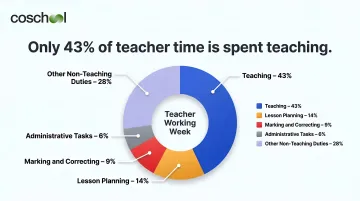
Globally, the pattern is consistent: teachers routinely work 50+ hours a week, with well under half of that time spent in front of students. The rest disappears into tasks students never see.
The compounding effect intensifies as class sizes grow and student needs diversify. Schools adopt new digital platforms without removing existing requirements, so each addition multiplies effort rather than replacing it.
This creates what researchers call "tech fatigue", a paradox where poorly introduced tools worsen burnout instead of alleviating it. LearnPlatform found that districts now access nearly 3,000 distinct edtech tools annually, a pattern mirrored globally, generating login overhead, duplicated data entry, and constant cognitive switching.
What's Really Driving Teacher Overload
Administrative Tasks Consume Disproportionate Time
Administrative work, such as attendance tracking, compliance documentation, report generation, and data entry, represents only 6% of teacher time according to TALIS averages, yet it's the highest-rated stressor globally. 52% of teachers cite administrative tasks as a source of stress, surpassing marking (40%) and lesson preparation (35%). In 18 education systems, stress from admin work increased even where actual time spent on it did not, suggesting the burden stems from fragmentation and perceived futility, not just hours.
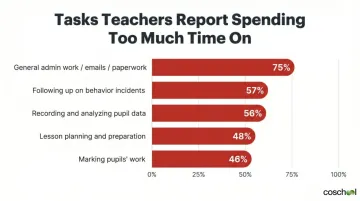
UK teachers, and teachers in comparable systems globally, report spending "too much time" on:
- General administrative work (emails, paperwork): 75%
- Following up on behavior incidents: 57%
- Recording, monitoring, and analyzing pupil data: 56%
- Planning or preparation of lessons: 48%
- Marking pupils' work: 46%
Lesson Planning and Differentiation Are Structurally Time-Intensive
Preparing materials for varied learning levels, adapting content for diverse student needs, and building assessments from scratch each cycle consumes massive effort without reusable systems. McKinsey's 2020 analysis found teachers spend approximately 11 hours per week on preparation alone.
Creating differentiated lesson plans manually, with separate materials for struggling learners, on-level students, and advanced learners, multiplies that effort further. Technology can reduce this through templating and AI-assisted generation, yet most teachers still build from scratch each cycle.
Assessment and Feedback Create a Recurring High-Effort Loop
Grading volume and the expectation of personalised feedback are difficult to sustain manually, particularly for teachers managing large classrooms. McKinsey reported teachers spend 6 hours weekly on evaluation and feedback. This cycle of assign, collect, grade, provide feedback, and return repeats each term with no reduction in effort. Objective assessments (multiple-choice quizzes, structured exercises) are prime candidates for technology intervention, yet many teachers still grade these manually.
Disconnected Tool Ecosystems Multiply Coordination Overhead
When teachers must navigate separate platforms for attendance, grading, communication, and content delivery, the coordination overhead itself becomes a workload driver. A 2025 survey found only 33% of teachers rated satisfaction with using multiple apps above 2 out of 10, yet 54% of administrators reported using 10–15 officially sanctioned apps.
This perception gap means tool proliferation often goes unaddressed. Each new platform adds separate logins, duplicate data entry, and training time, compounding the burden rather than relieving it.
Technology Strategies to Reduce Teacher Workload
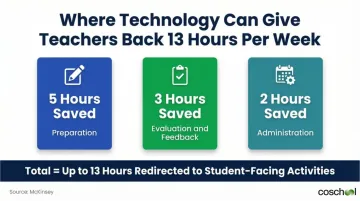
Workload reduction through technology isn't about digitizing everything. It's about deploying the right tools in the right way to replace effort, not layer onto it. McKinsey estimates that existing technology could help teachers reallocate approximately 13 hours per week from preparation (5 hours saved), evaluation (3 hours), and administration (2 hours) toward student-facing activities. Realizing this potential requires strategic selection and proper implementation.
Strategies That Reduce Workload by Changing What Teachers Use and Decide
Use AI-Assisted Lesson Planning and Resource Generation
AI tools can produce differentiated lesson materials, quizzes, and worksheets aligned to curriculum standards in minutes, reducing the prep cycle from hours to a fraction of the time. Case studies from Franklin Square School District documented teachers reducing preparation tasks from "hours to seconds" for specific activities using tools like Diffit and ChatGPT. Teachers generated adapted reading passages with summaries, vocabulary, and comprehension questions in under 20 seconds.
SchoolAi by Coschool enables teachers to generate customizable classroom resources, including lesson plans, question banks, engagement tips, and learning tips, directly supporting lesson preparation without requiring hours of manual content creation. The key is vetting AI output for accuracy, as generative tools can produce errors that require teacher review.
Automate Grading for Objective Assessments
Automated grading for quizzes, multiple-choice questions, and structured assignments removes a high-volume, low-judgment task from teachers' plates. This frees capacity for feedback that genuinely requires human insight:
- Narrative comments on written work and essays
- Guidance on problem-solving approaches
- Personalised encouragement for struggling students
Automation works best on repetitive tasks, not on the nuanced judgment calls that make teacher feedback meaningful.
Consolidate Onto Integrated Platforms
Replacing multiple disconnected apps with a single integrated platform reduces the daily friction of switching between tools, managing separate logins, and entering the same data more than once. For schools early in their technology adoption, consolidation is often the highest-return decision available. A unified system means:
- Data entered once and reused across all reporting needs
- Fewer context switches interrupting teachers' focus
- Cleaner records with less risk of inconsistency across tools
Strategies That Reduce Workload by Changing How Teaching Is Managed
Use Analytics Dashboards to Replace Manual Progress Tracking
AI-powered dashboards surface student performance patterns, flag students who need support, and identify learning gaps automatically, eliminating the need for teachers to manually comb through individual assignment data to form a picture of classroom health. With real-time visibility, teachers can intervene before small gaps compound into larger ones.
Automate Routine Parent and Student Communication
Scheduled notifications and automated progress updates reduce the back-and-forth communication burden while keeping parents meaningfully informed. Instead of composing individual progress emails, teachers configure the system once and let it handle routine reporting. Communication effort then focuses where it matters:
- Flagging concerns that need a personal conversation
- Sharing targeted feedback on specific learning milestones
- Responding to parent questions rather than initiating routine updates
Digitize Administrative Record-Keeping
Moving attendance, behaviour notes, and assessment records into unified digital systems removes duplication and reduces paperwork significantly. Cloud-based records are searchable, accessible to authorised staff, and eliminate the paper forms that pile up across a school year, without teachers acting as the filing system.
Strategies That Reduce Workload by Changing the Learning Environment Around Teachers
Implement Adaptive and Personalised Learning Technology
When students have access to tools that adjust content difficulty in real time based on their performance, teachers are no longer the sole source of individual support. This reduces the cognitive and logistical burden of managing differentiated instruction manually across a large class. Adaptive platforms allow students to work at their own pace on foundational skills while teachers focus on complex problem-solving and interaction.
Use Flipped or Blended Learning Models
Assigning foundational content delivery, such as video lessons, reading, and practice problems, to digital platforms outside class time allows teachers to use in-class hours for higher-value interaction. A meta-analysis found a moderate positive effect size (g = 0.50) on student performance from flipped classrooms, with effects ranging from weak in IT courses to strong in humanities. The model shifts time use without reducing learning quality, though it requires upfront investment in content creation.
Deploy AI Tutors to Handle Routine Student Queries
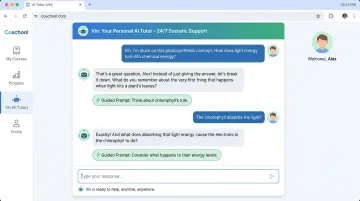
AI tutors can respond to repetitive comprehension questions, provide practice prompts, and give immediate feedback between classes, reducing the volume of individual follow-up requests teachers must handle. Vin, the school-integrated AI tutor in SchoolAi by Coschool, supports exactly this function, operating 24/7 to enable a 1:1 support experience for students without requiring teacher availability at every touchpoint. Vin uses a guided, Socratic approach to build understanding rather than simply providing answers, helping students develop critical thinking skills while offloading routine query handling from teachers.
Conclusion
Reducing teacher workload with technology is not about digitizing everything. It is about identifying where effort is being spent on tasks that technology can own, and freeing that time for the work only teachers can do. Administrative tasks, lesson prep, grading, and progress tracking consume over half of teacher working time, and most of these activities are automatable with the right tools.
Sustainable workload reduction is strategic and ongoing. Schools that see the greatest impact choose tools intentionally, train teachers properly, and evaluate whether each technology genuinely reduces demands or simply adds a new one. Technology works best when it eliminates repetitive, low-judgment tasks that block great teaching, not when it creates new ones.
When deployed thoughtfully, the right tools give teachers back the time and energy to focus on what matters most: building relationships, sparking curiosity, and guiding students through complex learning challenges.
Frequently Asked Questions
What are the 80/20 and 70/30 rules in teaching?
The 80/20 rule suggests teachers spend 80% of their time on high-impact activities like direct student engagement and only 20% on admin tasks. The 70/30 rule describes 70% student-centered activity versus 30% teacher-led instruction. When administrative work dominates, both ratios invert, and instructional quality suffers.
How can technology, including AI, reduce teachers' workload?
AI and education technology reduce teacher workload primarily by automating repetitive tasks (grading, reporting, resource creation), surfacing student insights without manual data review, and enabling students to access personalised support independently. This collectively frees teachers to focus on instruction and relationship-building rather than administrative work.
Does using more technology always reduce teacher workload?
Not necessarily. When tools are added without training or without retiring existing requirements, they increase burden through duplicated data entry and platform-switching. Workload reduction depends on choosing integrated, purposeful tools, and consolidating platforms rather than accumulating them.
What types of tasks can AI automate for teachers?
AI can automate objective grading and feedback generation, lesson material and quiz creation, student progress tracking and reporting, and routine parent or student communications. These are among the most time-intensive tasks in a teacher's week, and the most practical starting points for technology adoption.
How can schools ensure technology adoption doesn't create new burdens for teachers?
Schools should audit existing tools before adding new ones, provide structured training time, and limit the number of platforms teachers must use. Tracking impact through teacher surveys and time-on-task data confirms whether technology is actually delivering on its promise.
Can technology help teachers support students individually without increasing workload?
Yes. Adaptive learning platforms and AI tutors make individualised support scalable. Students receive real-time, personalised feedback and practice without requiring one-on-one teacher time for every interaction, making it practical even in classrooms of 40 or 50 students.